Hailey Morgan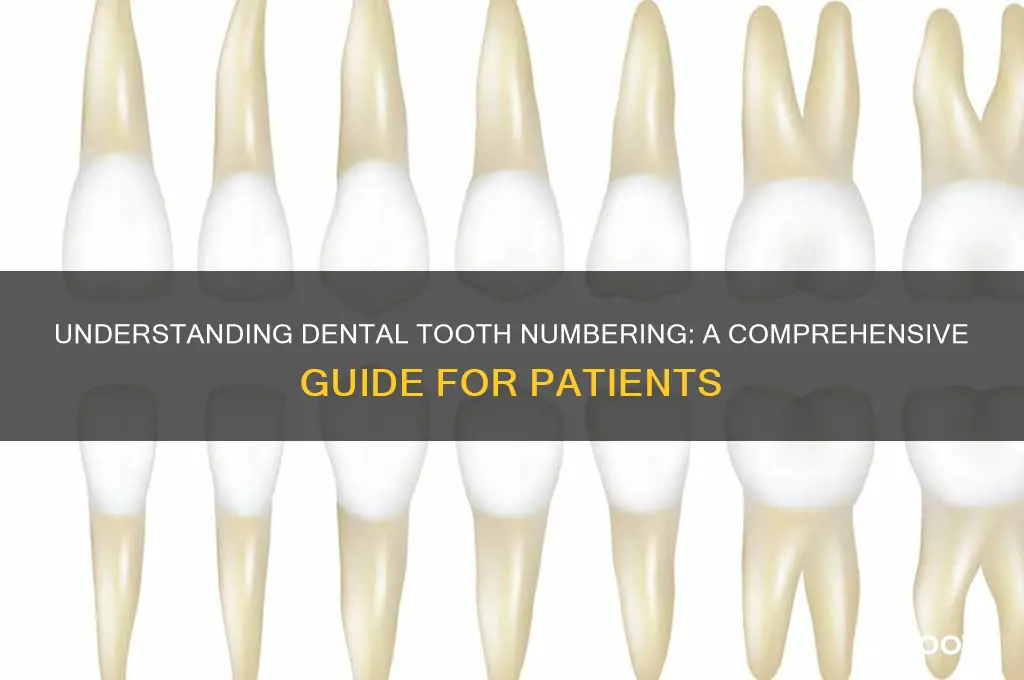
Dentists use a standardized numbering system to identify and record each tooth in a patient's mouth, ensuring clear communication and accurate documentation. The two most common systems are the Universal Numbering System, used primarily in the United States, and the Fédération Dentaire Internationale (FDI) World Dental Federation notation, which is widely adopted internationally. In the Universal system, teeth are numbered sequentially from 1 to 32, starting with the upper right third molar and moving clockwise around the mouth. The FDI system uses a two-digit code, where the first digit represents the quadrant (1 for upper right, 2 for upper left, 3 for lower left, and 4 for lower right) and the second digit identifies the tooth within that quadrant. These systems allow dentists to precisely locate and treat specific teeth, facilitating effective patient care and record-keeping.
| Characteristics | Values |
|---|---|
| Tooth Numbering System | Universal Numbering System (most widely used in the United States) |
| Total Teeth Count | 32 (permanent teeth in adults), 20 (primary/deciduous teeth in children) |
| Numbering Range | 1-32 for permanent teeth, A-T for primary teeth (Palmer Notation) |
| Upper Right Quadrant | Teeth numbered 1-8 (starting from the third molar to the central incisor) |
| Upper Left Quadrant | Teeth numbered 9-16 (starting from the central incisor to the third molar) |
| Lower Left Quadrant | Teeth numbered 17-24 (starting from the third molar to the central incisor) |
| Lower Right Quadrant | Teeth numbered 25-32 (starting from the central incisor to the third molar) |
| Primary Teeth Notation | Upper right: A-E, Upper left: F-J, Lower left: K-O, Lower right: P-T |
| Wisdom Teeth Numbers | 1, 16, 17, 32 (third molars in each quadrant) |
| Canine Teeth Numbers | 6, 11, 22, 27 (in permanent dentition) |
| Incisor Teeth Numbers | 7-10 (upper), 23-26 (lower) in permanent teeth |
| Premolar Teeth Numbers | 4-5 (upper right), 12-13 (upper left), 20-21 (lower left), 28-29 (lower right) |
| Molar Teeth Numbers | 2-3 (upper right), 14-15 (upper left), 18-19 (lower left), 30-31 (lower right) |
| International Standards | ISO 3950 (2016) for permanent teeth, Palmer Notation for primary teeth |
| Alternative Systems | Palmer Notation (for primary teeth), FDI World Dental Federation System |
| Purpose | Standardized identification for dental records, treatment planning, and communication |
What You'll Learn
- Universal Numbering System: Standard method, assigns numbers 1-32 to permanent teeth, 1-20 for primary teeth
- Palmer Notation Method: Uses symbols and quadrants to identify teeth, widely used in the U.S
- FDI World Dental Federation: Two-digit system, first digit for quadrant, second for tooth position
- Primary vs. Permanent Teeth: Different numbering systems for deciduous (baby) and permanent teeth
- Dental Quadrants Explained: Teeth divided into four quadrants, numbered counterclockwise starting from upper right

Universal Numbering System: Standard method, assigns numbers 1-32 to permanent teeth, 1-20 for primary teeth
Dentists rely on standardized systems to identify and document teeth accurately, ensuring clear communication in patient records and treatment plans. One such system, widely adopted in the United States, is the Universal Numbering System. This method assigns a unique number to each tooth, streamlining dental charting and reducing errors. For permanent teeth, the system uses numbers 1 through 32, while primary (baby) teeth are numbered 1 through 20. This simplicity makes it a preferred choice for many dental professionals.
The Universal Numbering System follows a clockwise pattern, starting from the patient’s upper right third molar (tooth #1) and ending at the upper left third molar (tooth #16). The numbering then continues to the lower left third molar (tooth #17) and concludes at the lower right third molar (tooth #32). For primary teeth, the sequence begins at the upper right second primary molar (tooth #1) and proceeds clockwise, ending at the lower right second primary molar (tooth #20). This structured approach ensures consistency, regardless of the patient’s age or dental condition.
While the Universal Numbering System is straightforward, it’s essential to note its limitations. For instance, it doesn’t account for supernumerary teeth (extra teeth) or missing teeth, which may require additional notation. Dentists often use modifiers like “A” or “B” for supernumerary teeth or indicate missing teeth with a strike-through. Despite these minor drawbacks, the system’s clarity and ease of use make it a cornerstone of dental practice, particularly in the U.S.
Adopting the Universal Numbering System offers practical benefits for both dentists and patients. For dentists, it simplifies record-keeping and facilitates collaboration with colleagues or specialists. Patients, on the other hand, can better understand their dental charts and treatment plans when teeth are identified with clear, consistent numbers. For example, if a dentist refers to “tooth #14” (upper left first molar), the patient can easily locate the tooth in question. This transparency fosters trust and improves communication in the dentist-patient relationship.
In summary, the Universal Numbering System is a reliable, standardized method for numbering teeth, assigning numbers 1-32 to permanent teeth and 1-20 to primary teeth. Its structured approach ensures consistency and clarity in dental documentation, though it may require additional notation for unique cases. By mastering this system, dental professionals can enhance their practice efficiency, while patients benefit from a clearer understanding of their oral health. Whether you’re a dentist or a patient, familiarity with this system is a valuable asset in navigating dental care.
How Dentists Repair Cracked Teeth: Treatment Options and Recovery Tips
You may want to see also
Palmer Notation Method: Uses symbols and quadrants to identify teeth, widely used in the U.S
The Palmer Notation Method is a quadrant-based system that simplifies tooth identification by dividing the mouth into four sections. Imagine the mouth as a clock face: the upper right quadrant (UR) corresponds to 12 o’clock, the upper left (UL) to 9 o’clock, the lower left (LL) to 6 o’clock, and the lower right (LR) to 3 o’clock. Each quadrant contains teeth numbered from 1 to 8, starting from the midline and moving outward. For example, UR1 is the upper right central incisor, while LL8 is the lower left wisdom tooth. This systematic approach ensures clarity and consistency, making it a staple in U.S. dental practices.
One of the key advantages of the Palmer Notation Method is its use of symbols to denote permanent and primary teeth. Permanent teeth are represented by numerals (1–8), while primary teeth are indicated by letters (A–E). For instance, UR-A refers to the primary upper right central incisor. This distinction is crucial for pediatric dentistry, where tracking deciduous teeth is essential for monitoring development and planning treatments. The method’s simplicity and adaptability make it a preferred choice for dentists, hygienists, and dental assistants alike.
While the Palmer Notation Method is widely used in the U.S., it’s important to note its limitations. Unlike the FDI World Dental Federation notation, which uses a two-digit numbering system, Palmer relies on quadrant symbols and single digits. This can sometimes lead to confusion when sharing records internationally. However, within the U.S. context, its straightforward design minimizes errors and streamlines communication among dental professionals. For example, a notation like LL5 instantly conveys the location of the lower left first molar, leaving no room for ambiguity.
Practical application of the Palmer Notation Method requires familiarity with tooth anatomy and quadrant divisions. Dental students and professionals often use visual aids, such as quadrant charts or mouth models, to reinforce their understanding. A useful tip is to practice by labeling teeth in a mirror or on a diagram until the system becomes second nature. For parents or caregivers, knowing this notation can help accurately describe a child’s dental issues to a dentist, ensuring prompt and precise care. Mastery of this method not only enhances professional competence but also improves patient communication and record-keeping.
Understanding the Dental Crown Procedure: How Dentists Cap a Tooth
You may want to see also
FDI World Dental Federation: Two-digit system, first digit for quadrant, second for tooth position
Dentists worldwide rely on standardized tooth numbering systems to ensure clear communication about specific teeth, regardless of language barriers. The FDI World Dental Federation's two-digit system stands out for its simplicity and universal applicability. This system divides the mouth into four quadrants, each assigned a unique first digit: 1 for the upper right, 2 for the upper left, 3 for the lower left, and 4 for the lower right. The second digit represents the tooth's position within the quadrant, starting from the midline and moving backward, ranging from 1 to 8 for permanent teeth and 1 to 5 for primary teeth.
Consider a practical example: Tooth "11" refers to the upper right central incisor, while "48" denotes the lower right wisdom tooth. This logical structure eliminates ambiguity, making it easier for dental professionals to document findings, plan treatments, and collaborate internationally. For instance, a dentist in Germany can share a patient's chart with a colleague in Brazil, and both will instantly understand which tooth is being referenced without needing translation.
However, mastering this system requires attention to detail. Beginners often confuse quadrants or misidentify tooth positions, especially in cases of missing or supernumerary teeth. A helpful tip is to visualize the mouth as a clock, with the midline at 12 o'clock, and practice mapping teeth onto this mental model. For children, remember that primary teeth use the same quadrant digits but with positions 1 to 5, simplifying the transition to permanent tooth notation later.
While the FDI system is globally recognized, it’s not without limitations. It doesn’t account for dental anomalies like fused teeth or microdontia, which may require additional descriptive notes. Nonetheless, its widespread adoption underscores its effectiveness in standardizing dental communication. For dental students, hygienists, or even patients curious about their dental charts, understanding this system demystifies the numbers behind their oral health records.
In conclusion, the FDI World Dental Federation's two-digit system is a cornerstone of dental notation, offering a clear, logical framework for identifying teeth across quadrants and positions. By familiarizing oneself with its structure and practicing its application, dental professionals and patients alike can navigate dental records with confidence and precision. Its global acceptance highlights its role in fostering seamless communication in an increasingly interconnected dental community.
Replacing Missing Teeth: Dental Solutions for a Complete Smile
You may want to see also
Primary vs. Permanent Teeth: Different numbering systems for deciduous (baby) and permanent teeth
Dentists use distinct numbering systems for primary (baby) and permanent teeth, reflecting their unique roles in oral development. Primary teeth, also known as deciduous teeth, are the first set of teeth that erupt in childhood, typically appearing between 6 months and 2 years of age. These teeth serve as placeholders for permanent teeth, guiding their proper alignment and aiding in speech and chewing. To identify primary teeth, dentists often use the Universal Numbering System, but with a twist: each tooth is assigned a letter (A-T) instead of a number, starting from the upper right quadrant and moving clockwise. For example, the upper right central incisor is labeled "E," while the lower left second molar is "S." This system ensures clarity when discussing these temporary teeth, which begin to exfoliate around age 6, making way for permanent successors.
Permanent teeth, on the other hand, are numbered using the Universal Numbering System with numbers 1-32, starting from the upper right third molar (tooth #1) and moving clockwise around the mouth. This system is widely adopted in the United States and simplifies communication between dental professionals. However, it’s crucial to note that the numbering for permanent teeth does not directly correlate with primary teeth. For instance, the primary upper right central incisor (E) is replaced by permanent tooth #8, not a direct numerical equivalent. This discrepancy highlights the need for dentists to clearly specify whether they are referring to primary or permanent teeth to avoid confusion.
The Federation Dentaire Internationale (FDI) Two-Digit System offers another approach, applicable to both primary and permanent teeth. In this system, the first digit represents the quadrant (1-4 for permanent teeth, 5-8 for primary teeth), and the second digit identifies the tooth within that quadrant. For example, permanent tooth #8 (upper right central incisor) is labeled "11," while the corresponding primary tooth is "51." This system’s advantage lies in its universality, as it is used globally, but it requires familiarity with its structure to avoid errors.
Choosing the right numbering system depends on context and geographic location. In pediatric dentistry, the letter-based system for primary teeth is often preferred for its simplicity and specificity. For permanent teeth, the Universal Numbering System remains dominant in the U.S., while the FDI system is favored internationally. Dentists must adapt their notation to ensure accurate record-keeping and treatment planning, especially when transitioning from primary to permanent dentition.
Practical tips for patients and parents include familiarizing themselves with the basics of these systems, particularly if working with multiple dental providers. For example, knowing that a child’s "E" tooth will eventually be replaced by tooth #8 can help demystify dental discussions. Additionally, maintaining clear communication with your dentist about which dentition is being discussed can prevent misunderstandings. Whether tracking the eruption of a child’s first tooth or planning an adult’s orthodontic treatment, understanding these numbering systems empowers individuals to take an active role in their oral health.
Cracked Tooth Repair: Dentist Techniques to Restore Your Smile
You may want to see also
Dental Quadrants Explained: Teeth divided into four quadrants, numbered counterclockwise starting from upper right
Dentists divide the mouth into four quadrants to systematically identify and treat teeth, ensuring clarity and precision in dental care. This method, known as the quadrant system, starts numbering teeth counterclockwise from the upper right side. Each quadrant contains a set of teeth, typically eight in adults, and follows a specific numbering sequence. Understanding this system is crucial for both dental professionals and patients, as it simplifies communication about specific teeth and their locations.
The first quadrant encompasses the upper right teeth, numbered 1 through 8, starting with the central incisor and ending with the third molar. This quadrant is often the starting point for dental examinations and treatments. For children, the numbering adjusts to accommodate primary teeth, but the quadrant system remains consistent. For instance, a child’s upper right central incisor is labeled as tooth A, while the adult equivalent is tooth 1. This adaptability makes the system universally applicable across age groups.
Moving counterclockwise, the second quadrant covers the upper left teeth, numbered 9 through 16. This quadrant mirrors the first in terms of tooth types but is distinct in its numbering. For example, the upper left central incisor is tooth 9, while the third molar is tooth 16. This symmetry simplifies the learning curve for both dentists and patients, as patterns in tooth numbering become evident. Understanding this symmetry is particularly useful when discussing treatments that affect multiple quadrants, such as orthodontic adjustments.
The third and fourth quadrants address the lower teeth, with the third quadrant (lower left) numbered 17 through 24 and the fourth quadrant (lower right) numbered 25 through 32. Here, the numbering continues the counterclockwise pattern established in the upper quadrants. For instance, the lower right central incisor is tooth 25, and the lower left third molar is tooth 24. This consistency ensures that every tooth in the mouth has a unique identifier, streamlining dental records and treatment plans.
Practical tips for patients include familiarizing themselves with their own dental charts, which often use this quadrant system. When discussing a specific tooth with a dentist, knowing its quadrant and number can expedite communication. For example, if a patient experiences pain in the upper right third molar, they can refer to it as tooth 8, helping the dentist quickly identify the issue. Additionally, parents can teach children this system to encourage better dental hygiene and awareness from a young age. By mastering the quadrant system, individuals can take a proactive role in their dental health.
How Braces Gently Pull Teeth Forward: The Orthodontic Process Explained
You may want to see also
Frequently asked questions
In the universal numbering system, teeth are numbered from 1 to 32, starting with the upper right third molar (tooth #1) and moving clockwise around the mouth to the upper left third molar (tooth #16). The numbering then continues to the lower left third molar (tooth #17) and proceeds clockwise to the lower right third molar (tooth #32).
Yes, for primary teeth, dentists often use the American Dental Association’s system, which assigns letters A through T instead of numbers. The sequence starts with the upper right second primary molar (A) and moves clockwise to the upper left second primary molar (J). It then continues to the lower left second primary molar (K) and ends with the lower right second primary molar (T).
The Palmer notation uses symbols and quadrants to identify teeth, which can be useful for hand-drawn charts. It divides the mouth into four quadrants (upper right, upper left, lower left, lower right) and uses numbers 1–8 for each tooth within a quadrant. However, the universal numbering system is more widely used due to its simplicity and consistency in digital records.