Hailey Morgan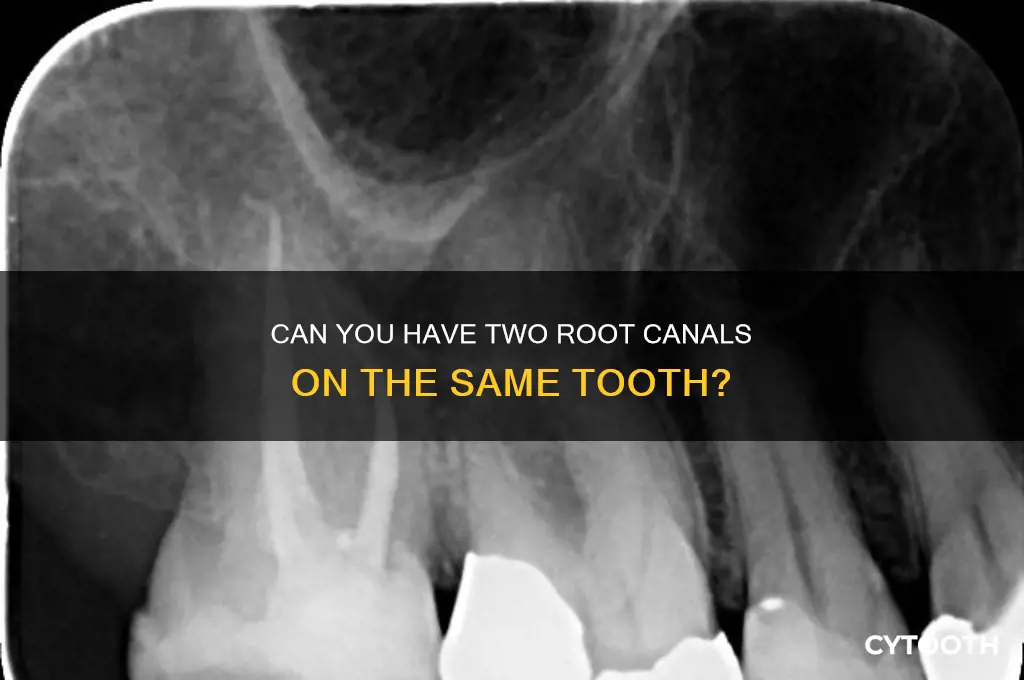
The question of whether you can have two root canals on the same tooth is a common concern among patients dealing with persistent dental issues. Root canal treatment, also known as endodontic therapy, is designed to save a severely damaged or infected tooth by removing the infected pulp and sealing the canal. While a single root canal procedure is typically sufficient, there are instances where a tooth may require a second root canal. This can occur if the initial treatment was incomplete, if new decay or infection develops, or if the tooth's complex anatomy was not fully addressed during the first procedure. Understanding the circumstances under which a second root canal might be necessary can help patients make informed decisions about their dental care and ensure the long-term health of their teeth.
| Characteristics | Values |
|---|---|
| Possibility of Two Root Canals on Same Tooth | Yes, but rare and only under specific circumstances. |
| Reasons for Second Root Canal | Persistent infection, missed canal during first procedure, reinfection. |
| Success Rate of Second Root Canal | Lower than first root canal; success depends on case complexity. |
| Alternative to Second Root Canal | Tooth extraction followed by implant or bridge. |
| Cost | Higher than initial root canal due to complexity and additional materials. |
| Recovery Time | Similar to first root canal (few days to a week). |
| Long-Term Prognosis | Varies; tooth may require retreatment or extraction if issues persist. |
| Frequency of Need | Uncommon; most root canals are successful on the first attempt. |
| Dental Specialist Involvement | Often requires an endodontist for complex cases. |
| Patient Factors | Overall oral health, tooth structure, and patient compliance affect outcome. |
What You'll Learn

Reasons for Multiple Root Canals
While it's uncommon, a single tooth can indeed undergo multiple root canal treatments. This scenario arises from specific circumstances where the initial procedure fails to fully address the underlying issue or new problems emerge over time.
Understanding the reasons behind this necessity is crucial for informed dental decisions.
One primary reason for a second root canal is persistent infection. Despite a dentist's best efforts, bacteria can sometimes remain within the intricate network of canals, leading to continued inflammation and pain. This may occur due to missed canals during the initial treatment, complex anatomy, or the presence of resistant bacterial strains. In such cases, a repeat procedure becomes necessary to thoroughly clean and disinfect the affected area, ensuring complete eradication of the infection.
For instance, a study published in the *Journal of Endodontics* found that 5-10% of root canal treatments require retreatment due to persistent infections.
Another scenario necessitating a second root canal is the development of new decay or damage to the tooth after the initial procedure. This can happen if the tooth's structural integrity is compromised, either due to a large filling, a weak crown, or trauma. Over time, bacteria can infiltrate the tooth through these weaknesses, leading to a new infection. In such cases, a second root canal, coupled with strengthening measures like a post and core build-up or a new crown, may be required to salvage the tooth.
It's important to note that the decision for a second root canal is not taken lightly. Dentists will thoroughly evaluate the tooth's condition through clinical examination, X-rays, and sometimes advanced imaging techniques like cone-beam computed tomography (CBCT). This comprehensive assessment helps determine the feasibility of retreatment and the likelihood of success.
While the prospect of a second root canal may seem daunting, advancements in endodontic techniques and materials have significantly improved success rates. With proper diagnosis, skilled treatment, and diligent aftercare, a tooth that has undergone multiple root canals can still function effectively for many years.
Super Glue for Teeth: Safe Emergency Fix or Dental Disaster?
You may want to see also
Success Rates of Re-Treatment
Root canal re-treatment, often necessary when a previous root canal fails, is a procedure with varying success rates. Studies indicate that the success rate of a second root canal on the same tooth ranges from 50% to 90%, depending on factors like the reason for failure, the skill of the endodontist, and the patient’s overall oral health. For instance, teeth with straightforward anatomy and minimal infection tend to fare better than those with complex root systems or chronic abscesses. Understanding these variables is crucial for patients considering re-treatment, as it sets realistic expectations and highlights the importance of early intervention.
One key determinant of re-treatment success is the cause of the initial root canal failure. Common reasons include missed canals, persistent infection, or inadequate sealing of the tooth. For example, a study published in the *Journal of Endodontics* found that teeth with missed canals during the first procedure had a re-treatment success rate of only 60%, compared to 85% for cases where the initial failure was due to a cracked filling. Patients should discuss the specific cause of their root canal failure with their endodontist, as this can significantly influence the likelihood of a successful outcome.
The expertise of the endodontist plays a pivotal role in re-treatment success. Specialized tools like microscopes and advanced imaging techniques, such as cone-beam computed tomography (CBCT), improve the accuracy of diagnosing and treating complex cases. For instance, using a surgical operating microscope can increase the detection of hidden canals by up to 25%. Patients should seek out endodontists with experience in re-treatment and access to these technologies to maximize their chances of success.
Post-re-treatment care is equally critical. Patients must follow their dentist’s instructions meticulously, including taking prescribed antibiotics (e.g., 500 mg of amoxicillin three times daily for 7–10 days if infection is present) and avoiding hard or chewy foods for at least two weeks. A permanent restoration, such as a crown, should be placed within 30 days of the procedure to prevent fracture or reinfection. Neglecting these steps can significantly reduce the success rate, even if the re-treatment itself was performed flawlessly.
Comparatively, re-treatment success rates are often lower than those of initial root canals, which typically boast a 90–95% success rate. However, re-treatment remains a viable option for preserving a natural tooth, avoiding extraction, and preventing the need for more invasive procedures like implants. For patients weighing their options, the potential benefits of re-treatment—such as maintaining proper bite alignment and preventing adjacent teeth from shifting—often outweigh the risks, especially when performed by a skilled professional.
Alcohol After Tooth Filling: Safe or Risky? Expert Advice
You may want to see also
Procedure Differences in Second Treatment
A second root canal on the same tooth, often termed a "re-treatment," is not a mere repeat of the initial procedure. It demands a more meticulous approach, as the dentist must navigate a tooth already altered by the first treatment. The primary difference lies in the complexity of accessing the root canal system. During the initial root canal, the dentist creates a straightforward path to the pulp chamber. In a re-treatment, however, this path may be obstructed by the previous filling material, gutta-percha, or even structural changes in the tooth.
The first step in a second root canal involves carefully removing the existing restoration and any obstructions. This requires precision and specialized instruments to avoid damaging the tooth further. Dentists often use operating microscopes and ultrasonic instruments to enhance visibility and precision during this delicate process. Once the canals are accessible, the dentist must thoroughly clean and shape them again, removing any remaining infected tissue or debris. This step is crucial, as residual bacteria can lead to persistent infection.
One significant procedural difference is the increased focus on disinfection. Since the tooth has already been infected once, the risk of recurrent infection is higher. Dentists may use stronger irrigating solutions, such as higher concentrations of sodium hypochlorite (up to 6%), or incorporate additional antimicrobial agents like chlorhexidine. These measures ensure that all bacteria are eradicated, reducing the likelihood of future complications. The irrigation process may also take longer to ensure thorough disinfection of the intricate canal system.
Another critical aspect is the assessment of the tooth's structural integrity. A tooth that has undergone a root canal once is inherently weaker. During re-treatment, the dentist must evaluate whether the tooth can withstand the procedure and subsequent restoration. In some cases, a post and core build-up may be necessary to reinforce the tooth before placing a new crown. This additional step ensures the longevity of the treated tooth, especially in molars or teeth with extensive decay.
Patient management also differs in a second root canal. Patients may experience more anxiety or discomfort due to the complexity of the procedure and their previous experience. Dentists often take extra time to explain the process, address concerns, and provide adequate anesthesia. Post-operative care instructions are equally important, emphasizing the need for strict oral hygiene and follow-up visits to monitor healing. While a second root canal is more challenging, it can still save a tooth from extraction, making it a valuable option for patients seeking to preserve their natural dentition.
Can Orthodontists Repair Chipped Teeth? Expert Insights and Solutions
You may want to see also
Risks and Complications Involved
While it is technically possible to perform two root canals on the same tooth, it is not a common practice and carries significant risks and complications. The primary concern is the structural integrity of the tooth. Each root canal procedure involves removing infected or damaged pulp, cleaning the canals, and sealing them. Repeated procedures can weaken the tooth, making it more susceptible to fractures or splits, especially under the pressure of chewing or biting. For instance, molars, which bear the brunt of chewing forces, are particularly vulnerable. A fractured tooth may require extraction if the damage is severe, leading to additional dental work such as implants or bridges.
Another critical risk is the potential for incomplete disinfection during the second root canal. The first procedure may leave behind residual bacteria or debris in the intricate canal system, which can be difficult to fully eradicate in a subsequent treatment. This increases the likelihood of reinfection, leading to persistent pain, swelling, or abscess formation. Antibiotics may be prescribed to manage infection, but they are not a substitute for thorough disinfection. For example, a common antibiotic like amoxicillin (500 mg, three times daily for 7–10 days) might be used, but its effectiveness depends on the extent of the infection and the patient’s overall health.
The success rate of a second root canal is generally lower than that of the first. Studies indicate that while a primary root canal has a success rate of around 90–95%, a retreatment drops to approximately 75–85%. This disparity is partly due to the complexity of revisiting a tooth that has already been treated and filled. Specialized tools and techniques, such as ultrasonic instruments or microscopes, may be required to navigate the previously filled canals, adding to the cost and time of the procedure. Patients should weigh these factors carefully, as repeated treatments can also lead to increased sensitivity, discomfort, and financial burden.
From a practical standpoint, prevention is key to avoiding the need for multiple root canals. Maintaining excellent oral hygiene, including regular brushing, flossing, and dental check-ups, can significantly reduce the risk of tooth decay and infection. For those with a history of dental issues, fluoride treatments or dental sealants may provide additional protection. If a second root canal is deemed necessary, patients should seek a specialist, such as an endodontist, who has the expertise to handle complex cases. Post-treatment care, including avoiding hard or sticky foods and using desensitizing toothpaste, can help preserve the tooth and minimize complications. Ultimately, while a second root canal is an option, it should be considered a last resort due to the inherent risks involved.
Can Adult Teeth Regenerate? Exploring the Science Behind Tooth Regrowth
You may want to see also
Cost and Insurance Coverage
The cost of a second root canal on the same tooth can be significantly higher than the first, often ranging from $800 to $2,000, depending on the complexity and location. This price disparity arises from the increased difficulty of the procedure, as the tooth’s anatomy may be compromised from the initial treatment. For instance, removing a second set of instruments or addressing post-treatment complications like fractures can drive up costs. Understanding these factors is crucial for budgeting and financial planning.
Insurance coverage for a second root canal varies widely, with many plans treating it as a separate claim. While some policies cover up to 50-80% of the cost, others may deny coverage altogether, deeming it a pre-existing condition. For example, PPO plans often offer better coverage compared to HMO plans, but even then, annual maximums and waiting periods can limit benefits. To navigate this, patients should review their policy details, contact their insurer directly, and request a pre-authorization to avoid unexpected out-of-pocket expenses.
A comparative analysis reveals that dental savings plans or discount programs can be a viable alternative for those without insurance. These plans typically offer 10-60% discounts on root canal procedures, reducing the cost to $400-$1,200. However, they require an annual membership fee, usually between $100-$200. For individuals facing a second root canal, weighing the long-term savings against the upfront cost of such plans can be a practical strategy.
Descriptively, the financial burden of a second root canal can be alleviated through payment plans or financing options offered by dental offices. Many clinics partner with third-party providers like CareCredit, which offers 0% interest for 6-24 months on qualifying treatments. Patients should inquire about these options early, as application processes can take time. Additionally, some dentists may provide sliding-scale fees or discounts for cash payments, making it essential to discuss all available options during the initial consultation.
Persuasively, investing in preventive care can reduce the likelihood of needing a second root canal. Regular check-ups, proper oral hygiene, and timely treatment of cavities can save thousands in the long run. For example, a $150 filling is far less costly than a $1,000 root canal, let alone a second one. By prioritizing dental health, patients can avoid the financial and physical discomfort associated with repeated procedures, making prevention a cost-effective and wise choice.
Veneers for Missing Teeth: Are They a Viable Replacement Option?
You may want to see also
Frequently asked questions
Yes, it is possible to have two root canals on the same tooth if the tooth has multiple roots or canals that require treatment.
A tooth may need two root canals if it has multiple canals (e.g., molars often have 2-4 canals) that are infected or damaged, requiring separate treatment for each.
It is not uncommon, especially for molars, which naturally have multiple roots and canals. However, it depends on the tooth's anatomy and the extent of the damage.
The procedure is similar to a single root canal, but it may take longer due to treating multiple canals. Pain and discomfort are managed with anesthesia, just like in a standard root canal.