Ethan Brooks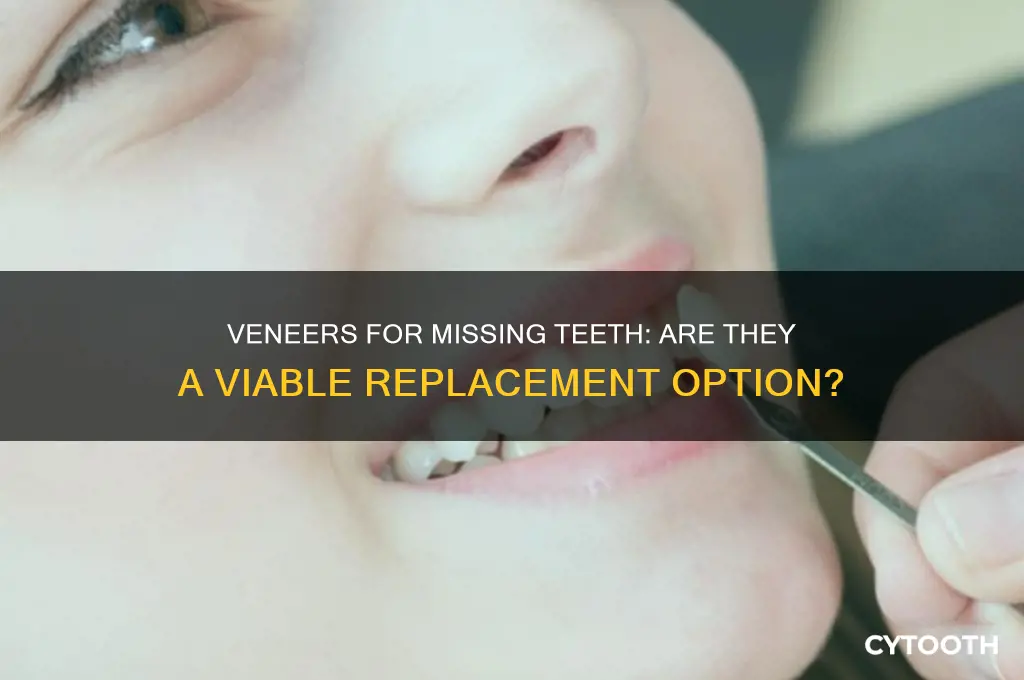
Veneers are a popular cosmetic dental solution designed to enhance the appearance of existing teeth by covering their front surface, but they are not a suitable option for replacing a missing tooth. Veneers are typically made from porcelain or composite resin and are bonded to the front of healthy teeth to improve their color, shape, size, or alignment. However, they rely on the presence of a stable underlying tooth structure for support and cannot function independently. For missing teeth, more appropriate solutions include dental implants, bridges, or dentures, which are specifically designed to replace the entire tooth structure, restore functionality, and maintain oral health. Consulting a dentist is essential to determine the best treatment option for your specific needs.
| Characteristics | Values |
|---|---|
| Can Veneers Replace a Missing Tooth? | No, veneers cannot replace a missing tooth. |
| Purpose of Veneers | Cosmetic solution to improve appearance of existing teeth. |
| Functionality | Covers front surface of teeth to enhance shape, color, or size. |
| Missing Tooth Solutions | Implants, bridges, dentures, or partial dentures are recommended. |
| Veneers Application | Applied to existing, structurally sound teeth. |
| Durability | 10–15 years with proper care, but not suitable for missing teeth. |
| Cost Comparison | Veneers are less expensive than implants but not a replacement option. |
| Aesthetic Benefit | Improves smile appearance but does not address gaps from missing teeth. |
| Dental Health Impact | Does not restore chewing function or prevent shifting of remaining teeth. |
| Alternative for Gaps | Can be used to close small gaps between teeth but not for missing teeth. |
| Expert Recommendation | Dentists advise against veneers for missing teeth; opt for restorative options. |
What You'll Learn
- Veneers vs. Implants: Comparing options for missing teeth
- Veneers as cosmetic solutions, not replacements for missing teeth
- Limitations of veneers in addressing tooth loss
- Alternative treatments for missing teeth: Bridges, implants, dentures
- Veneers for adjacent teeth to enhance appearance after tooth loss

Veneers vs. Implants: Comparing options for missing teeth
Veneers cannot replace a missing tooth on their own, but they can be part of a solution in specific scenarios. Typically, veneers are thin shells of porcelain or composite resin bonded to the front of existing teeth to improve appearance. However, in cases where a tooth is missing, veneers might be used in conjunction with other dental procedures, such as a bridge, to fill the gap. For instance, a veneer can be placed on the adjacent teeth to support a pontic (artificial tooth) that replaces the missing one. This approach is less invasive than an implant but relies on altering healthy teeth for support.
Implants, on the other hand, are a standalone solution for missing teeth. They involve surgically placing a titanium post into the jawbone, which acts as a root for a custom-made crown. Unlike veneers, implants do not require altering adjacent teeth and provide a more permanent, natural-looking result. However, the process is more complex, requiring multiple appointments and a healing period of 3–6 months for osseointegration (fusion of the implant with the bone). Implants are ideal for patients with good oral health and sufficient bone density, typically adults over 18 with fully developed jaws.
When comparing veneers and implants, cost and longevity are key factors. Veneers are generally less expensive upfront, ranging from $800 to $2,500 per tooth, but they last 10–15 years and require replacement. Implants cost $3,000 to $4,500 per tooth but can last a lifetime with proper care. Additionally, implants preserve jawbone health by stimulating bone growth, whereas veneers do not address bone loss associated with missing teeth. For patients with multiple missing teeth, implants may also support dentures or bridges, offering greater stability than veneer-supported options.
A practical tip for deciding between the two: consider your long-term goals and oral health. If you’re seeking a quick, cosmetic fix and have healthy adjacent teeth, a veneer-supported bridge might suffice. However, if you prioritize durability, bone health, and minimal impact on surrounding teeth, implants are the superior choice. Consult a dentist for a personalized assessment, including X-rays and 3D imaging, to determine the best option for your specific case. Remember, while veneers can play a role in addressing missing teeth, implants remain the gold standard for comprehensive, long-term restoration.
Can Tooth Resorption Be Halted? Understanding Causes and Treatment Options
You may want to see also
Veneers as cosmetic solutions, not replacements for missing teeth
Veneers, those thin shells of porcelain or composite resin, are often hailed as a quick fix for a dazzling smile. But can they step in where a tooth is missing? The short answer is no. Veneers are strictly cosmetic solutions, designed to enhance the appearance of existing teeth, not to replace missing ones. They bond to the front surface of teeth, masking imperfections like stains, chips, or gaps, but they lack the structural integrity to function as a replacement for a missing tooth.
Imagine trying to build a bridge with only the decorative railing – it simply won’t hold. Veneers rely on the underlying tooth for support and stability, which is absent when a tooth is missing.
While veneers can’t replace a missing tooth, they can sometimes play a supporting role in a comprehensive treatment plan. For instance, if a missing tooth has created a gap that affects the appearance of adjacent teeth, veneers can be used to reshape and align the remaining teeth, creating a more harmonious smile. Think of it as framing a beautiful painting – the veneers enhance the overall aesthetic, but the painting itself (the remaining teeth) is still the focal point. However, this approach requires careful planning and consultation with a dentist to ensure the veneers don’t compromise the health or function of the remaining teeth.
It’s crucial to understand that ignoring a missing tooth and opting for veneers alone can lead to serious oral health issues. The gap left by a missing tooth can cause surrounding teeth to shift, leading to misalignment, bite problems, and even jaw pain. Additionally, the empty socket can become a breeding ground for bacteria, increasing the risk of gum disease and infection. Veneers, being purely cosmetic, do nothing to address these underlying issues. They’re like putting a band-aid on a broken bone – it might look better, but the problem remains.
A proper replacement for a missing tooth, such as a dental implant, bridge, or denture, is essential to maintain oral health and functionality.
In conclusion, while veneers can work wonders for enhancing the appearance of existing teeth, they are not a substitute for a missing tooth. Their role is cosmetic, not structural. For a complete and healthy smile, addressing the missing tooth with appropriate restorative dentistry is paramount. Veneers can then be considered as a complementary treatment to refine the aesthetics, but they should never be seen as a standalone solution for tooth replacement. Remember, a beautiful smile starts with a healthy foundation.
Sore Tooth, Headache Connection: Understanding the Surprising Link
You may want to see also
Limitations of veneers in addressing tooth loss
Veneers, while transformative for enhancing the appearance of existing teeth, are not a viable solution for replacing a missing tooth. Their primary function is to act as a cosmetic shell, bonded to the front surface of a natural tooth. This fundamental design limitation precludes them from addressing the structural and functional void left by a missing tooth.
Veneers lack the necessary foundation and anchoring system to support a prosthetic tooth in the gap. Unlike dental implants or bridges, which integrate with the jawbone or adjacent teeth, veneers rely solely on the integrity of the underlying tooth structure for stability. Attempting to use a veneer to "fill" a gap would result in an unstable, non-functional restoration prone to failure.
Consider the analogy of a house foundation. Veneers are akin to decorative siding, enhancing the appearance of a structurally sound building. They cannot, however, replace a missing wall or provide the necessary support for a new addition. Similarly, veneers excel at masking imperfections on existing teeth but are ill-equipped to address the complex challenges of tooth replacement.
A critical limitation lies in their inability to stimulate the jawbone. When a tooth is lost, the underlying bone begins to resorb due to lack of stimulation. This process, known as bone loss, can lead to significant oral health complications, including further tooth loss and facial structure changes. Veneers, being purely cosmetic, do not engage the jawbone in any way, allowing bone loss to progress unchecked.
While veneers offer remarkable aesthetic benefits for existing teeth, their application in addressing tooth loss is severely limited. They lack the structural integrity, anchoring mechanisms, and bone-stimulating properties necessary for a successful and long-lasting replacement. Patients seeking solutions for missing teeth should explore options like dental implants, bridges, or dentures, which are specifically designed to restore both function and aesthetics. Consulting with a qualified dentist is crucial for determining the most suitable treatment plan based on individual needs and oral health status.
Can a Tooth Implant Be Removed? Understanding the Process and Possibilities
You may want to see also
Alternative treatments for missing teeth: Bridges, implants, dentures
Veneers, while transformative for enhancing the appearance of existing teeth, cannot replace a missing tooth. They are thin shells bonded to the front surface of teeth to improve aesthetics, not to fill gaps. For missing teeth, alternative treatments like bridges, implants, and dentures offer functional and cosmetic solutions.
Bridges: A Fixed, Reliable Option
Dental bridges are a tried-and-true method for replacing one or more missing teeth. They consist of artificial teeth anchored to adjacent natural teeth or implants. A traditional bridge involves crowns on the neighboring teeth to support the prosthetic, while a cantilever bridge uses a single adjacent tooth for support. Bridges restore chewing function and prevent remaining teeth from shifting. However, they require altering healthy teeth for crown placement, which can weaken them over time. Maintenance is key; regular flossing under the bridge using a threader or water flosser prevents decay. Bridges typically last 5–15 years with proper care, making them a durable but not permanent solution.
Implants: The Gold Standard for Longevity
Dental implants are the closest alternative to natural teeth, both in function and appearance. They involve a titanium post surgically embedded into the jawbone, topped with a crown. Implants stimulate bone growth, preventing the jawbone atrophy common with tooth loss. The process requires multiple steps: implant placement, healing (3–6 months), and crown attachment. While more expensive and time-consuming than other options, implants can last a lifetime with good oral hygiene. They are ideal for patients with sufficient bone density and overall health. Post-surgery, avoid hard or sticky foods for 6–8 weeks to ensure proper healing.
Dentures: Versatile and Non-Invasive
Dentures are removable appliances that replace multiple missing teeth or an entire arch. Partial dentures attach to existing teeth with clasps, while complete dentures rest on the gums. Modern dentures are more comfortable and natural-looking than their predecessors, thanks to advancements in materials like acrylic resin and porcelain. They are a cost-effective solution, particularly for older adults or those with extensive tooth loss. However, dentures may slip or cause discomfort if not fitted properly. Regular cleaning and overnight soaking are essential to prevent bacterial buildup. Adjustments may be needed over time as the jawbone changes shape.
Choosing the Right Option: Factors to Consider
Selecting the best treatment depends on individual needs, budget, and oral health. Bridges are ideal for those seeking a fixed, less invasive option but require healthy adjacent teeth. Implants offer unparalleled stability and longevity but demand a higher investment and surgical candidacy. Dentures provide a non-surgical, affordable solution for extensive tooth loss but require adaptation and maintenance. Consulting a dentist is crucial to evaluate bone density, gum health, and lifestyle factors. For instance, smokers may face higher implant failure rates, while those with gag reflexes might find dentures challenging. Each option restores not just teeth but confidence, ensuring a functional and aesthetic smile.
Fixing a Broken Tooth with a Filling: Repair Options Explained
You may want to see also
Veneers for adjacent teeth to enhance appearance after tooth loss
Veneers cannot replace a missing tooth, but they can play a strategic role in enhancing the appearance of adjacent teeth after tooth loss. When a tooth is missing, the surrounding teeth may shift, causing gaps or misalignment that affect the overall smile aesthetic. Veneers, thin shells of porcelain or composite resin, can be applied to these adjacent teeth to improve symmetry, color, and shape, creating a seamless and harmonious look. This approach is particularly effective when the missing tooth is replaced with a more functional solution, such as an implant or bridge, and veneers are used to refine the surrounding area.
Consider a scenario where a patient loses a lateral incisor due to trauma. The adjacent central incisors may appear uneven or discolored in comparison. By placing veneers on these central incisors, a dentist can match their size, shade, and contour to create a balanced smile. This method is especially useful when the patient is not a candidate for immediate tooth replacement or is awaiting a more permanent solution. Veneers act as a cosmetic bridge, ensuring the smile remains visually appealing during the transition period.
While veneers for adjacent teeth are a viable option, they require careful planning. The dentist must assess the health of the remaining teeth, as veneers involve removing a small amount of enamel. Patients should also be aware that veneers are a long-term commitment, with porcelain veneers lasting 10–15 years and composite veneers requiring replacement every 5–7 years. Additionally, maintaining oral hygiene is crucial to prevent decay around the veneered teeth. Regular check-ups and professional cleanings are essential to ensure the longevity of the treatment.
A comparative analysis highlights the advantages of using veneers in this context. Unlike orthodontic treatments, which can take months to correct tooth alignment, veneers provide immediate cosmetic improvement. They are also less invasive than crowns, which require more extensive tooth reduction. However, veneers are not a standalone solution for missing teeth and should be part of a comprehensive treatment plan. For instance, combining veneers with a dental implant can address both function and aesthetics, offering a complete smile restoration.
In practice, patients considering veneers for adjacent teeth should consult with a cosmetic dentist to explore their options. The process typically involves three steps: consultation and planning, tooth preparation, and veneer placement. During the consultation, the dentist will discuss expectations, take impressions, and select the appropriate shade. Tooth preparation involves removing a thin layer of enamel, followed by the custom fabrication of veneers. Finally, the veneers are bonded to the teeth, with adjustments made for a perfect fit. This tailored approach ensures that the veneers not only enhance the appearance but also blend naturally with the patient’s smile.
Can Retainers Cause Tooth Death? Understanding the Risks of Tight Wear
You may want to see also
Frequently asked questions
No, veneers cannot replace a missing tooth. Veneers are thin shells designed to cover the front surface of existing teeth to improve their appearance, not to replace missing teeth.
Alternatives to veneers for replacing a missing tooth include dental implants, bridges, or dentures, which are specifically designed to fill the gap left by a missing tooth.
Yes, veneers can be used alongside other treatments like implants or bridges to enhance the appearance of adjacent teeth while the missing tooth is replaced by a more suitable restorative option.