Samantha Blake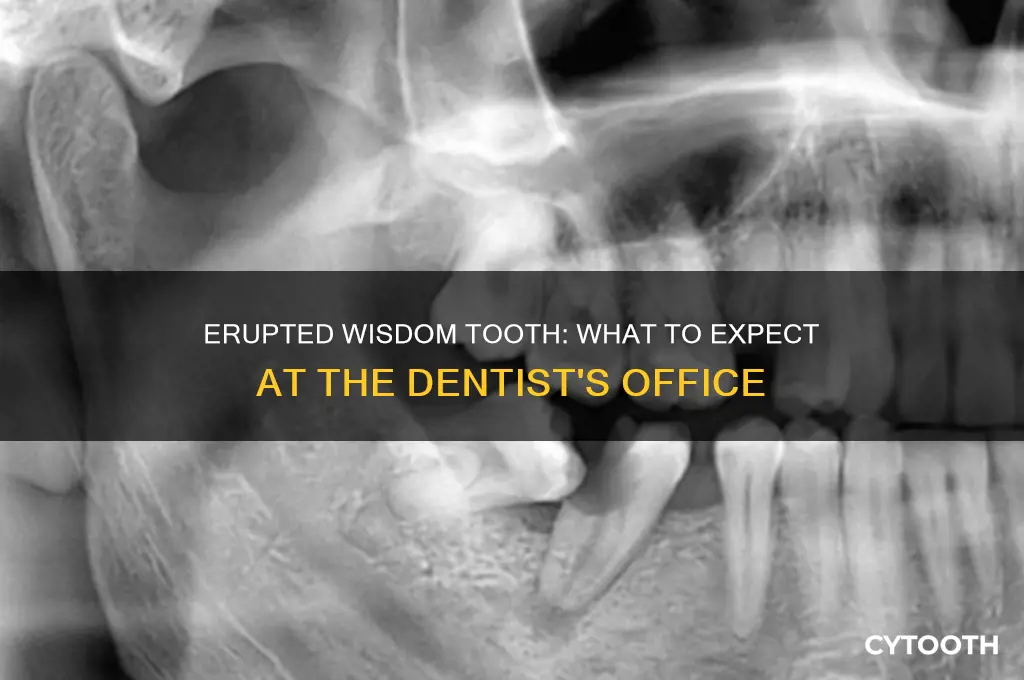
When a wisdom tooth erupts, a dentist will first conduct a thorough examination, often including X-rays, to assess its position, alignment, and potential impact on surrounding teeth. If the tooth is fully erupted and properly aligned, the dentist may simply monitor it for signs of decay, gum disease, or infection. However, if the tooth is impacted, partially erupted, or causing pain, crowding, or other complications, the dentist may recommend extraction to prevent further issues. During the procedure, the dentist will use local anesthesia to numb the area and may perform a simple or surgical extraction depending on the tooth’s complexity. Post-extraction, the dentist will provide aftercare instructions to ensure proper healing and minimize discomfort.
| Characteristics | Values |
|---|---|
| Assessment | Dentist examines the erupted wisdom tooth for impaction, infection, decay, or crowding. |
| X-rays | Takes dental X-rays to evaluate tooth position, root structure, and surrounding bone. |
| Cleaning and Debridement | Removes plaque, tartar, and debris around the wisdom tooth and gums. |
| Pain Management | Prescribes pain relievers or anti-inflammatory medications if necessary. |
| Antibiotics | Administers antibiotics if infection (e.g., pericoronitis) is present. |
| Extraction Recommendation | Advises extraction if the tooth is impacted, causing pain, or at risk of complications. |
| Monitoring | Schedules follow-up visits to monitor the tooth’s alignment and health. |
| Oral Hygiene Instructions | Provides guidance on proper brushing and flossing around the wisdom tooth. |
| Referral to Specialist | Refers to an oral surgeon if extraction is complex or high-risk. |
| Preventive Care | Recommends regular check-ups to prevent future issues. |
What You'll Learn
- Assessment and Diagnosis: Examines tooth position, gum health, and potential complications like impaction or infection
- Pain Management: Provides relief through medications, numbing agents, or temporary solutions before extraction
- Extraction Decision: Determines if removal is necessary based on alignment, decay, or crowding risks
- Surgical Procedure: Performs extraction, possibly under anesthesia, ensuring minimal discomfort and complications
- Post-Extraction Care: Offers instructions for healing, including cleaning, diet, and follow-up appointments

Assessment and Diagnosis: Examines tooth position, gum health, and potential complications like impaction or infection
A dentist's first step in addressing an erupted wisdom tooth is a comprehensive assessment and diagnosis, a critical phase that dictates the subsequent treatment plan. This process involves a meticulous examination of the tooth's position, the surrounding gum health, and any potential complications that may have arisen due to the eruption. The dentist will employ a combination of visual inspection, palpation, and diagnostic tools to gather the necessary information.
During the assessment, the dentist will evaluate the wisdom tooth's angulation and its relationship to the adjacent teeth. A tooth that has erupted at an awkward angle or is partially impacted can lead to various issues. For instance, a mesial angulation, where the tooth tilts forward, may cause crowding or damage to the neighboring molar. In contrast, a horizontal impaction can result in severe pain, infection, and even cyst formation. The dentist will also check for any signs of decay or gum disease, as wisdom teeth are particularly susceptible due to their location and often difficult-to-reach position.
Example: A common scenario is a patient presenting with a partially erupted lower wisdom tooth, causing pain and swelling. Upon examination, the dentist finds the tooth is mesially angled, pressing against the second molar, and the gums are inflamed, indicating a potential infection.
The diagnostic process is not solely focused on the tooth itself but also on the surrounding structures. Gum health is a critical aspect, as the soft tissues can be easily irritated by a newly erupted wisdom tooth. Dentists will look for signs of inflammation, bleeding, or the presence of a pericoronal flap—a small flap of gum tissue that can trap food and bacteria, leading to infection. In some cases, a dentist might use a periodontal probe to measure the depth of the gum pockets around the tooth, assessing the risk of periodontal disease.
Analysis and Takeaway: The assessment and diagnosis phase is a delicate balance between visual observation and the dentist's tactile expertise. It requires a thorough understanding of dental anatomy and the potential complications associated with wisdom teeth. By examining the tooth's position and gum health, dentists can predict and prevent future issues, such as impaction, infection, or damage to adjacent teeth. This initial evaluation is crucial in determining whether the wisdom tooth can be managed with conservative treatments or if more invasive procedures, like extraction, are necessary.
Practical Tips: Patients can aid in this process by providing a detailed history of symptoms, including any pain, swelling, or difficulty in cleaning the area. Maintaining good oral hygiene practices, especially around the wisdom tooth, can also help prevent complications. Regular dental check-ups are essential, as they allow dentists to monitor the eruption process and intervene early if needed, potentially avoiding more complex and painful issues.
Identifying the Tooth Located Just in Front of Your Wisdom Tooth
You may want to see also
Pain Management: Provides relief through medications, numbing agents, or temporary solutions before extraction
Erupted wisdom teeth often bring discomfort, and immediate pain management is crucial before deciding on extraction. Dentists typically start with a thorough assessment to determine the severity of the pain and the underlying cause, such as impaction, infection, or gum inflammation. Based on this evaluation, they tailor a pain relief strategy that may include medications, numbing agents, or temporary solutions to provide comfort until a permanent resolution can be implemented.
Medications play a central role in managing wisdom tooth pain. Over-the-counter analgesics like ibuprofen (400–600 mg every 6 hours) or acetaminophen (500–1000 mg every 4–6 hours) are commonly recommended for adults. For more severe pain, dentists may prescribe stronger medications, such as opioids (e.g., hydrocodone or codeine), though these are used sparingly due to their side effects and addiction risks. Antibiotics, like amoxicillin (500 mg every 8 hours), may also be prescribed if an infection is present, as bacterial complications can exacerbate pain and delay healing. Always follow the dentist’s dosage instructions and avoid self-medicating beyond recommended limits.
Numbing agents offer localized relief for acute discomfort. Topical gels containing benzocaine (e.g., Orajel) can be applied directly to the affected area to numb the gums temporarily. For more targeted relief, dentists might administer a local anesthetic like lidocaine via injection during an office visit. This is particularly useful if the pain is severe or if a procedure like a dental cleaning or minor intervention is needed before extraction. While numbing agents provide quick relief, they are not a long-term solution and should be used as directed to avoid tissue irritation or overdose.
Temporary solutions can bridge the gap until extraction is feasible. Warm saltwater rinses (1/2 teaspoon of salt in 8 ounces of water) reduce inflammation and soothe irritated gums. Applying a cold compress externally for 15–20 minutes at a time can numb the area and reduce swelling. For those with partially erupted teeth, dental wax or orthodontic wax can be applied to sharp edges to prevent gum irritation. These methods are simple, cost-effective, and can be implemented at home, but they are not substitutes for professional care.
In summary, pain management for an erupted wisdom tooth involves a combination of medications, numbing agents, and temporary solutions tailored to the patient’s needs. While these measures provide immediate relief, they are stopgaps until a definitive treatment, such as extraction, can be performed. Always consult a dentist to ensure the chosen approach is safe and appropriate for your specific situation.
Wisdom Tooth Removal: Understanding Anesthesia Types and Options
You may want to see also
Extraction Decision: Determines if removal is necessary based on alignment, decay, or crowding risks
Wisdom teeth, or third molars, often emerge between the ages of 17 and 25, but their arrival isn’t always welcome. Dentists evaluate erupted wisdom teeth critically, considering whether they pose risks that outweigh their benefits. The extraction decision hinges on three key factors: alignment, decay potential, and crowding risks. Misaligned wisdom teeth can press against adjacent molars, causing pain or shifting existing dental work. Decay is another concern, as partially erupted teeth are difficult to clean, creating a breeding ground for bacteria. Crowding, particularly in smaller jaws, can undo years of orthodontic treatment. Each case demands a tailored assessment, balancing the tooth’s current state with its long-term impact on oral health.
Consider a scenario where a wisdom tooth erupts at a sharp angle, pressing against the second molar. Over time, this pressure can lead to enamel wear, gum inflammation, or even cyst formation. In such cases, extraction becomes a preventive measure rather than a reactive one. Dentists may recommend removal if the tooth’s position obstructs proper cleaning, increasing the risk of cavities or gum disease. For younger patients (under 25), early extraction is often advised, as the roots are less developed, and recovery is faster. However, age alone isn’t decisive; a 30-year-old with a well-aligned, fully erupted wisdom tooth may retain it with proper care.
The decision-making process involves a combination of clinical examination and diagnostic imaging. X-rays or 3D scans reveal the tooth’s position, root structure, and proximity to nerves. For instance, a wisdom tooth close to the inferior alveolar nerve may require a specialist (oral surgeon) for extraction to avoid complications like numbness. Dentists also assess jaw size and dental history. Patients with a history of braces or limited jaw space are more likely to face crowding issues, tipping the scales toward removal. Practical tips for patients include monitoring symptoms like persistent pain, swelling, or difficulty opening the mouth, which signal the need for immediate evaluation.
Persuasively, retaining a wisdom tooth is only advisable when it’s fully functional, accessible for cleaning, and not disrupting the dental arch. Even then, vigilant maintenance is required. Electric toothbrushes with small heads and water flossers can aid in cleaning hard-to-reach areas. However, the risks often outweigh the benefits, particularly when decay or misalignment is evident. Extraction, while invasive, prevents long-term issues like periodontal disease or damage to adjacent teeth. Dentists weigh these factors conservatively, prioritizing the patient’s overall oral health and future dental stability.
In conclusion, the extraction decision for an erupted wisdom tooth is a nuanced one, rooted in alignment, decay risks, and crowding potential. It’s not a one-size-fits-all approach but a careful evaluation of individual circumstances. Patients should engage in open dialogue with their dentist, understanding the rationale behind the recommendation. Whether retaining or removing, the goal remains the same: preserving oral health and functionality for the long term.
Easiest Wisdom Tooth Extraction: Which Type Requires Less Effort?
You may want to see also
Surgical Procedure: Performs extraction, possibly under anesthesia, ensuring minimal discomfort and complications
Erupted wisdom teeth often require surgical extraction due to impaction, infection, or misalignment. This procedure, typically performed by an oral surgeon or experienced dentist, prioritizes patient comfort and safety. Here’s what to expect: the process begins with a thorough evaluation, including X-rays, to determine the tooth’s position and potential risks. Local anesthesia is commonly used to numb the area, though intravenous sedation or general anesthesia may be recommended for complex cases or anxious patients. The surgeon then makes a small incision in the gum tissue to access the tooth, carefully removes it, and stitches the site to promote healing. Post-operative care instructions are provided to minimize complications such as dry socket or infection.
The decision to extract a wisdom tooth surgically is not taken lightly. Dentists consider factors like the tooth’s angle, depth, and proximity to nerves. For instance, a partially erupted tooth at a sharp angle may press against the adjacent molar, causing pain or decay, necessitating removal. The procedure itself typically takes 45–90 minutes, depending on complexity. Patients are advised to avoid eating or drinking for 8–12 hours before surgery if sedation is used. Afterward, swelling and discomfort are normal for a few days, managed with ice packs and prescribed pain relievers like ibuprofen (600 mg every 6 hours) or acetaminophen (1000 mg every 6 hours).
Comparatively, surgical extraction of a wisdom tooth is more invasive than a simple tooth removal but is often necessary for long-term oral health. Unlike a routine extraction, this procedure may involve bone removal or sectioning the tooth into smaller pieces for easier extraction. For example, impacted wisdom teeth often require this approach due to their position beneath the gum line or within the jawbone. While the thought of surgery can be daunting, modern techniques and anesthesia ensure the process is as painless as possible. Patients typically report minimal discomfort during the procedure itself, with most sensations occurring post-operatively.
A critical aspect of this surgical procedure is the focus on minimizing complications. Dentists take precautions such as administering antibiotics (e.g., amoxicillin 500 mg, 3 times daily for 5 days) to prevent infection, especially in patients with compromised immune systems or systemic conditions like diabetes. Additionally, techniques like using dissolvable sutures and applying protective dressings reduce the risk of dry socket, a painful condition where the blood clot at the extraction site dislodges. Patients are advised to avoid smoking, drinking through straws, and vigorous rinsing for at least 48 hours post-surgery to protect the healing site.
In conclusion, surgical extraction of an erupted wisdom tooth is a precise, patient-centered procedure designed to alleviate pain, prevent complications, and restore oral health. By combining advanced techniques with careful planning and aftercare, dentists ensure the process is as smooth and comfortable as possible. Whether under local anesthesia or sedation, patients can expect a well-managed experience tailored to their needs, with clear instructions for a swift recovery. This proactive approach not only addresses immediate concerns but also prevents future issues, making it a vital intervention for problematic wisdom teeth.
Wisdom Tooth Removal: Essential Dental Care Procedure Explained
You may want to see also
Post-Extraction Care: Offers instructions for healing, including cleaning, diet, and follow-up appointments
After a wisdom tooth extraction, the first 24 hours are critical for preventing complications like dry socket, an agonizing condition where the blood clot dislodges, exposing bone and nerves. During this period, avoid rinsing, spitting forcefully, or using straws, as these actions create suction that can dislodge the clot. Instead, gently rinse with warm salt water (1/2 teaspoon of salt in 8 ounces of water) starting 24 hours post-extraction, repeating this every 2–3 hours to keep the area clean and reduce inflammation.
Diet plays a pivotal role in healing. For the first 24–48 hours, stick to soft, lukewarm foods like yogurt, mashed potatoes, or smoothies to avoid irritating the extraction site. Gradually reintroduce semi-soft foods as tolerated, but steer clear of crunchy, spicy, or hot items that could disrupt the healing process. Hydration is essential, but opt for water or mild herbal teas, avoiding alcohol and caffeine, which can interfere with blood clot stability and pain management.
Pain management is another cornerstone of post-extraction care. Dentists typically recommend over-the-counter pain relievers like ibuprofen (600 mg every 6 hours) or acetaminophen (500–1000 mg every 4–6 hours) for adults, adjusting dosages based on age and medical history. For severe pain, a dentist may prescribe stronger medications. Applying an ice pack to the cheek in 20-minute intervals during the first 24 hours can reduce swelling, followed by a warm compress after 48 hours to promote circulation and healing.
Follow-up appointments are non-negotiable, even if healing seems straightforward. A dentist will inspect the extraction site for infection, ensure proper healing, and remove any remaining debris or sutures. These appointments are typically scheduled 1–2 weeks post-extraction, but immediate contact is necessary if symptoms like persistent pain, fever, or foul-smelling discharge arise, as these could indicate complications requiring urgent intervention.
By adhering to these cleaning, dietary, and medical guidelines, patients can significantly reduce the risk of complications and ensure a smoother, faster recovery. Post-extraction care isn’t just about following rules—it’s about creating an environment where healing can thrive, allowing you to return to normalcy with minimal discomfort.
Pre-Wisdom Tooth Surgery Checklist: Essential Steps for a Smooth Recovery
You may want to see also
Frequently asked questions
If your wisdom tooth has fully erupted and is properly aligned, the dentist will likely clean the area, monitor it for signs of decay or gum disease, and recommend regular check-ups to ensure it remains healthy.
If an erupted wisdom tooth is causing pain, the dentist will examine it for issues like infection, gum inflammation, or crowding. Treatment may include cleaning, medication, or extraction if the tooth is impacting oral health.
A dentist may recommend removing an erupted wisdom tooth if it’s causing problems like decay, gum disease, crowding, or difficulty cleaning. However, if it’s healthy and functional, extraction may not be necessary.
For gum inflammation around an erupted wisdom tooth, the dentist may clean the area thoroughly, prescribe antimicrobial mouthwash or antibiotics, and advise improved oral hygiene practices. If the issue persists, extraction might be considered.