Olivia Bennett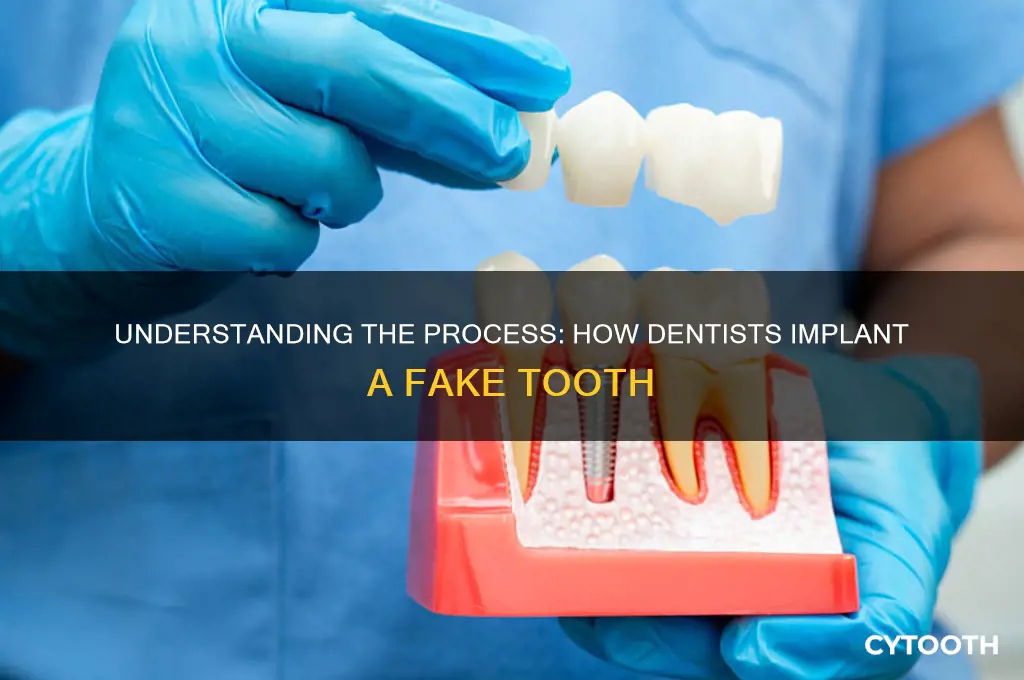
Dentists use a precise and multi-step process to place a fake tooth, also known as a dental implant or prosthetic tooth. The procedure typically begins with a thorough examination and consultation to determine the best type of implant for the patient's needs. Once the implant type is chosen, the dentist will surgically place a titanium post into the jawbone, which acts as the root of the new tooth. Over several months, the post fuses with the bone in a process called osseointegration, providing a stable foundation for the artificial tooth. After the post has fully integrated, an abutment is attached to connect the implant to the prosthetic tooth. Finally, a custom-made crown, designed to match the patient's natural teeth in shape, size, and color, is securely placed onto the abutment, restoring both function and aesthetics to the patient's smile.
| Characteristics | Values |
|---|---|
| Procedure Type | Dental Implant, Dental Bridge, or Partial Denture |
| Initial Consultation | Examination, X-rays, and treatment planning |
| Tooth Extraction (if needed) | Removal of damaged or decayed tooth before placement |
| Implant Placement (for implants) | Titanium post surgically inserted into jawbone |
| Healing Period (for implants) | 3–6 months for osseointegration (bone fusion with implant) |
| Abutment Placement | Connector piece attached to the implant for crown support |
| Crown/Prosthesis Creation | Custom-made artificial tooth (crown, bridge, or denture) |
| Material Used | Porcelain, ceramic, zirconia, or metal alloys |
| Crown Attachment | Secured to implant, bridge, or denture framework |
| Adjustment and Fitting | Ensuring proper bite, alignment, and comfort |
| Aftercare Instructions | Oral hygiene, regular check-ups, and avoiding hard foods initially |
| Longevity | 10–20+ years with proper care (implants); 5–15 years (bridges/dentures) |
| Cost Range (USD) | $1,500–$6,000 (implant); $500–$1,200 per tooth (bridge); $300–$500 (denture) |
| Pain Management | Local anesthesia during procedure; mild discomfort post-op |
| Success Rate | 95–98% for dental implants; varies for bridges and dentures |
| Alternative Options | Removable partial dentures, resin-bonded bridges |
What You'll Learn
- Implant Placement: Surgical insertion of titanium post into jawbone as a root for the fake tooth
- Abutment Attachment: Connecting piece placed on the implant to hold the crown securely
- Crown Fabrication: Custom-made artificial tooth designed to match natural teeth in shape and color
- Healing Process: Osseointegration, where the implant fuses with the jawbone, typically taking 3-6 months
- Final Placement: Permanent attachment of the crown to the abutment, completing the restoration

Implant Placement: Surgical insertion of titanium post into jawbone as a root for the fake tooth
Titanium, a biocompatible metal, serves as the cornerstone of modern dental implants. Its unique ability to osseointegrate—fuse with living bone—makes it the material of choice for implant posts. During the surgical phase, the dentist meticulously drills a small hole into the jawbone, precisely positioning the titanium post to mimic the root of a natural tooth. This procedure, often performed under local anesthesia, requires a high degree of precision to ensure stability and long-term success. Post-surgery, patients may experience mild discomfort, managed with over-the-counter pain relievers like ibuprofen (600 mg every 6 hours as needed).
The success of implant placement hinges on adequate bone density and overall oral health. Prior to surgery, a comprehensive evaluation—including 3D imaging and bone density tests—is conducted to determine candidacy. Patients with insufficient bone may require a preliminary procedure, such as a bone graft, to strengthen the jaw. For adults over 65, this step is particularly crucial, as age-related bone loss can compromise implant stability. Smoking, a known inhibitor of osseointegration, is strongly discouraged during the healing phase, which typically spans 3–6 months.
Comparatively, implant placement offers distinct advantages over traditional tooth replacement methods like bridges or dentures. Unlike bridges, which rely on adjacent teeth for support, implants stand independently, preserving the integrity of neighboring teeth. Dentures, while non-invasive, often lack the stability and functionality of implants. A study published in the *Journal of Dental Research* found that implants have a 95% success rate over 10 years, significantly outperforming other options. This durability, coupled with natural aesthetics, makes implants a preferred choice for patients seeking a permanent solution.
The surgical insertion of a titanium post is just the first step in a multi-phase process. After osseointegration, an abutment—a connector piece—is attached to the post, followed by the placement of a custom-made crown. This final restoration is meticulously crafted to match the color, shape, and size of the patient’s natural teeth, ensuring seamless integration into the smile. Maintenance is straightforward: regular brushing, flossing, and dental check-ups every six months are essential to prevent complications like peri-implantitis, an inflammatory condition akin to gum disease.
For those considering implants, understanding the commitment involved is key. The process, from initial consultation to final restoration, can span several months and requires patience. However, the transformative impact on oral health and self-confidence makes it a worthwhile investment. Practical tips include adhering strictly to post-operative care instructions, avoiding hard or sticky foods during the healing period, and maintaining a balanced diet rich in calcium and vitamin D to support bone health. With proper care, a dental implant can last a lifetime, offering a durable and natural-looking solution to tooth loss.
Bear Head Tooth Mushroom Hibernation: Survival Secrets of Hericium Americanum
You may want to see also
Abutment Attachment: Connecting piece placed on the implant to hold the crown securely
The abutment attachment is a critical yet often overlooked component in the process of installing a fake tooth, serving as the bridge between the dental implant and the final crown. This small, precision-engineered piece is designed to ensure a secure, stable, and aesthetically pleasing fit. Without it, the crown would lack the necessary support to function properly or withstand the forces of daily use, such as chewing and biting. Understanding its role and the steps involved in its placement can demystify the process for patients and highlight its importance in the overall success of the procedure.
From an analytical perspective, the abutment attachment is a marvel of dental engineering. It must be custom-fitted to the patient’s implant and oral anatomy, requiring precise measurements and material selection. Typically made from titanium, zirconia, or other biocompatible materials, the abutment is chosen based on factors like the patient’s gum health, aesthetic preferences, and the location of the missing tooth. For instance, a titanium abutment is often preferred for its strength and durability, while a zirconia abutment may be selected for its natural tooth-like appearance, particularly in the anterior region. The angulation and contour of the abutment are equally critical, as they influence the final crown’s alignment and the overall bite mechanics.
Instructively, the placement of the abutment attachment follows a systematic process. Once the dental implant has fully integrated with the jawbone—a process known as osseointegration that typically takes 3–6 months—the dentist will reopen the gum tissue to expose the implant. The abutment is then screwed or cemented onto the implant, depending on the type of abutment and implant system used. A healing cap may be placed temporarily to shape the gum tissue around the abutment, ensuring a natural emergence profile. After the gum tissue has healed, usually within 2 weeks, the final impressions are taken to fabricate the crown. This step-by-step approach ensures that the abutment provides a stable foundation for the crown, mimicking the function of a natural tooth root.
Persuasively, investing in a high-quality abutment attachment is essential for long-term success. While it may seem like a minor component, a poorly fitted or low-quality abutment can lead to complications such as crown loosening, gum irritation, or even implant failure. Patients should discuss their options with their dentist, considering factors like material biocompatibility, aesthetic goals, and budget. For example, a patient with a high smile line may prioritize a zirconia abutment to avoid any grayish discoloration that can sometimes show through the gums with titanium. Conversely, a patient with heavy bite forces may benefit from the added strength of titanium.
Comparatively, the abutment attachment in implant dentistry can be likened to the foundation of a house. Just as a strong foundation ensures the stability and longevity of a building, a well-designed and properly placed abutment ensures the durability and functionality of the dental implant. Unlike traditional bridges or dentures, which rely on adjacent teeth for support, implants and their abutments provide a standalone solution that preserves bone health and maintains facial structure. This comparison underscores the abutment’s role as a cornerstone of modern restorative dentistry, offering patients a reliable and natural-looking replacement for missing teeth.
Descriptively, the abutment attachment is a testament to the precision and artistry of dental craftsmanship. Its design must balance form and function, ensuring not only structural integrity but also harmony with the patient’s natural dentition. The abutment’s emergence profile—the way it rises through the gum tissue—is meticulously shaped to mimic the contour of a natural tooth, preventing food trapping and promoting healthy gum attachment. When the final crown is attached, the abutment disappears from view, leaving behind a seamless restoration that blends effortlessly with the patient’s smile. This attention to detail is what transforms a mechanical process into a work of dental art.
Understanding Dental Implants: A Single Tooth Replacement Solution Explained
You may want to see also
Crown Fabrication: Custom-made artificial tooth designed to match natural teeth in shape and color
Crown fabrication is a meticulous process that begins with a detailed impression of the patient’s mouth, ensuring the artificial tooth integrates seamlessly with the natural dentition. Dentists use high-precision materials like porcelain or zirconia, chosen for their durability and ability to mimic the translucency and texture of real teeth. The impression is sent to a dental lab, where technicians craft the crown using advanced CAD/CAM technology, allowing for millimeter-level accuracy in shape and contour. This step is critical because even minor discrepancies can affect bite alignment or aesthetic harmony.
Once the crown is fabricated, the dentist prepares the affected tooth by removing decayed or damaged portions and reshaping it to accommodate the restoration. This preparation involves reducing the tooth’s size by about 1–2 millimeters, a process that requires local anesthesia to ensure patient comfort. The prepared tooth is then cleaned and etched to create a rough surface, enhancing the bond between the natural tooth and the crown. Temporary crowns are often placed while the permanent one is being finalized, protecting the tooth and maintaining functionality during the interim period.
Color matching is a nuanced art in crown fabrication, as the goal is to replicate not just the hue but also the subtle gradients and light-reflecting properties of adjacent teeth. Dentists use shade guides and digital imaging tools to select the most accurate color match, considering factors like gum tone and patient skin complexion. Modern techniques, such as layering ceramic materials, allow for the recreation of natural tooth characteristics, including translucency at the edges and opacity near the gum line. This attention to detail ensures the crown blends indistinguishably with the surrounding teeth.
After the crown is cemented in place, the dentist checks the bite alignment and makes adjustments as needed to ensure proper occlusion. Patients are advised to avoid hard or sticky foods for the first 24–48 hours post-placement, allowing the cement to fully set. Long-term care involves regular brushing, flossing, and dental check-ups to monitor the crown’s integrity and surrounding gum health. With proper maintenance, a well-fabricated crown can last 10–15 years, restoring both function and confidence to the patient’s smile.
Dental Implants vs. Bridges, Dentures: Which Tooth Replacement Option is Best?
You may want to see also
Healing Process: Osseointegration, where the implant fuses with the jawbone, typically taking 3-6 months
The success of a dental implant hinges on osseointegration, a biological process where the implant post fuses with the jawbone. This isn't a quick fix; it's a deliberate dance between titanium and bone, typically unfolding over 3 to 6 months. During this time, the implant, often made of biocompatible titanium, acts as a scaffold, encouraging bone cells to grow and intertwine with its surface. This creates a strong, stable foundation for the artificial tooth, mimicking the natural tooth root.
Imagine a seed taking root in soil. Osseointegration is similar, but instead of a seed, it's a titanium post, and the soil is your jawbone. Over time, the bone cells "take root" around the implant, anchoring it firmly in place. This biological bond is crucial for the long-term success of the implant, ensuring it can withstand the forces of chewing and speaking.
Several factors influence the speed and success of osseointegration. Bone density plays a key role; denser bone heals faster and provides a stronger foundation. Overall health is also important. Conditions like diabetes or smoking can impair healing and increase the risk of implant failure. Following your dentist's post-operative instructions meticulously is vital. This includes maintaining excellent oral hygiene, avoiding smoking, and adhering to any prescribed medications, such as antibiotics or anti-inflammatory drugs.
Regular check-ups during the healing period allow your dentist to monitor progress and address any concerns promptly. While the waiting period may seem lengthy, patience is paramount. Rushing the process can compromise the implant's stability and longevity.
Think of osseointegration as an investment in your oral health. By allowing this natural healing process to unfold, you're ensuring a strong, durable foundation for your new tooth. The result? A smile that looks, feels, and functions just like your natural teeth.
How Do Toothbrush Bristles Stay Secure and Effective Over Time?
You may want to see also
Final Placement: Permanent attachment of the crown to the abutment, completing the restoration
The final placement of a dental crown is a meticulous process that marks the culmination of a restorative journey. This stage involves permanently attaching the custom-made crown to the abutment, a structure prepared to support the new tooth. The abutment, often a dental implant or a shaped natural tooth, serves as the foundation for the crown, ensuring stability and functionality. This step is critical, as it determines the long-term success of the restoration, affecting both aesthetics and oral health.
Steps to Permanent Attachment:
- Preparation and Cleaning: Before the final placement, the abutment and surrounding area are thoroughly cleaned to remove any debris or temporary cement. This ensures a clean surface for the adhesive, promoting a strong bond. The dentist may use a small brush or air-powder abrasive to achieve this.
- Try-In: The crown is first placed on the abutment without cement to check its fit, bite alignment, and appearance. This trial run allows for any necessary adjustments to be made. The dentist will assess the occlusion (how the teeth come together) and ensure the crown matches the natural teeth in shape and color.
- Cementation: Once the fit is confirmed, the crown is removed, and a small amount of dental cement is applied to the inner surface. The type of cement used varies, with options like zinc phosphate, resin-modified glass ionomer, or resin cements being common choices. Each has its advantages, such as strength, aesthetics, or fluoride release, and the dentist will select the most suitable one for the patient's needs.
- Placement and Setting: The crown is then carefully positioned onto the abutment, ensuring it is seated correctly. The dentist will remove any excess cement and use a light-curing unit to harden the cement if a resin-based material is used. This step requires precision to avoid trapping cement, which could lead to future complications.
- Final Adjustments: After the cement sets, the dentist will check the bite again and make any final adjustments to ensure comfort and proper function. This may involve slight modifications to the crown's surface to achieve the ideal occlusion.
Cautions and Considerations:
- Cement Selection: The choice of cement is crucial, as it affects the crown's retention and longevity. For instance, resin cements provide a strong bond but require precise placement due to their quick setting time.
- Excess Cement Removal: Inadequate removal of excess cement can lead to gum irritation, decay, or even crown failure. Dentists use specialized tools and techniques to ensure a clean finish.
- Patient Comfort: Throughout the procedure, the dentist must ensure the patient's comfort, especially during the try-in and final placement, as these steps require the patient to keep their mouth open for extended periods.
The permanent attachment of a dental crown is a precise and delicate procedure, demanding skill and attention to detail. It is the final step in a process that transforms a patient's smile and oral health. With the right techniques and materials, dentists can achieve a seamless and durable restoration, providing patients with a functional and aesthetically pleasing solution to tooth loss or damage. This stage is where the art and science of dentistry converge, creating a lasting impact on the patient's well-being.
Exploring the Unique Bear Head Tooth Mushroom: Identification and Uses
You may want to see also
Frequently asked questions
Dentists first assess the site, which may involve removing a damaged tooth or cleaning the area. They then take impressions or digital scans of the mouth to create a custom-fitted fake tooth, ensuring it matches the shape, size, and color of the natural teeth.
Fake teeth, also known as dental crowns or implants, are typically made from materials like porcelain, ceramic, zirconia, or metal alloys. The choice depends on factors such as durability, aesthetics, and the patient’s preferences.
For a dental crown, the tooth is prepared by removing a portion of the natural tooth structure, and the crown is cemented in place. For a dental implant, a titanium post is surgically placed into the jawbone, and once healed, an abutment and crown are attached to it.
The timeline varies. A dental crown typically takes 2-3 visits over a few weeks, including preparation and placement. Dental implants take longer, usually 3-6 months, due to the need for the implant to fuse with the jawbone (osseointegration) before the final crown is placed.