Logan Hayes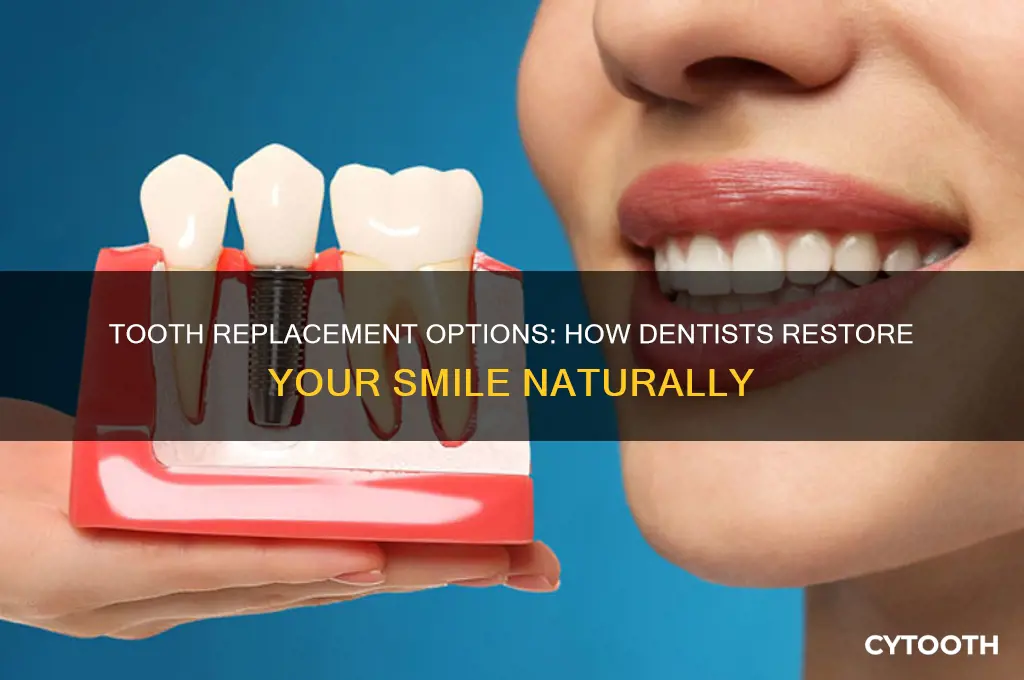
Dentists employ various methods to replace a missing tooth, each tailored to the patient’s specific needs and oral health. The most common solutions include dental implants, which involve surgically placing a titanium post into the jawbone to act as a root for a custom-made crown; dental bridges, which anchor a prosthetic tooth to adjacent natural teeth; and removable partial dentures, which can be taken out for cleaning. The choice of treatment depends on factors such as the patient’s bone density, overall health, and budget. Advances in technology and materials have made these replacements highly durable and natural-looking, restoring both function and aesthetics to the patient’s smile.
| Characteristics | Values |
|---|---|
| Methods of Tooth Replacement | Dental Implants, Dental Bridges, Dentures (Partial/Complete) |
| Dental Implants | Titanium post surgically placed into jawbone, topped with a crown |
| Dental Bridges | Fixed prosthetic supported by adjacent teeth or implants |
| Dentures | Removable partial or complete sets of artificial teeth |
| Procedure Time | Implants: 3–6 months (including healing); Bridges/Dentures: 2–3 weeks |
| Durability | Implants: 25+ years; Bridges: 10–15 years; Dentures: 5–10 years |
| Cost Range (USD) | Implants: $3,000–$6,000 per tooth; Bridges: $1,500–$4,500; Dentures: $300–$5,000 |
| Invasiveness | Implants: Surgical; Bridges: Minimal; Dentures: Non-invasive |
| Maintenance | Implants: Regular brushing/flossing; Bridges: Special floss; Dentures: Soaking/cleaning |
| Aesthetic Appeal | Implants: Most natural-looking; Bridges: High; Dentures: Varies |
| Bone Health Impact | Implants: Preserves jawbone; Bridges/Dentures: May cause bone loss |
| Success Rate | Implants: 95–98%; Bridges: 90–95%; Dentures: 85–90% |
| Suitable Candidates | Implants: Healthy gums/bone; Bridges: Adjacent healthy teeth; Dentures: Multiple missing teeth |
| Recovery Time | Implants: 1–2 weeks post-surgery; Bridges/Dentures: Immediate use |
| Material Used | Implants: Titanium/Ceramic; Bridges: Porcelain/Metal; Dentures: Acrylic/Porcelain |
What You'll Learn
- Initial Consultation and Assessment: Examines oral health, discusses replacement options, and plans treatment
- Tooth Extraction Process: Removes damaged tooth, ensures minimal discomfort, and prepares site for replacement
- Implant Placement Surgery: Inserts titanium post into jawbone, acts as artificial root for new tooth
- Abutment and Crown Fitting: Attaches abutment to implant, places custom-made crown for natural appearance
- Post-Procedure Care and Maintenance: Provides aftercare instructions, schedules follow-ups, ensures long-term success of tooth replacement

Initial Consultation and Assessment: Examines oral health, discusses replacement options, and plans treatment
The journey to replacing a missing tooth begins with a crucial first step: the initial consultation and assessment. This appointment is not merely a formality but a comprehensive evaluation that sets the stage for a successful restoration. During this visit, the dentist becomes a detective, meticulously examining the oral landscape to uncover the unique needs and challenges of each patient.
A Comprehensive Oral Examination: The dentist will start by assessing the overall oral health, which is fundamental to determining the suitability of various tooth replacement options. This includes a thorough inspection of the gums, remaining teeth, and jawbone. For instance, the presence of gum disease or bone loss might influence the choice of treatment. The dentist may take X-rays or 3D scans to evaluate bone density and identify any hidden issues, ensuring a precise diagnosis. This step is critical, as it allows the dentist to tailor the treatment plan to the patient's specific anatomy and oral health status.
Discussing Replacement Options: A Collaborative Approach
Here, the dentist educates the patient about the available tooth replacement solutions, such as dental implants, bridges, or dentures. Each option has its advantages and considerations. For younger adults with healthy bones, implants might be the preferred choice due to their durability and natural appearance. However, for older patients or those with certain medical conditions, dentures could be a more suitable, cost-effective solution. The dentist will explain the procedures, materials used, and expected outcomes, ensuring the patient understands the benefits and potential risks. This dialogue empowers patients to make informed decisions about their oral health.
Treatment Planning: A Strategic Roadmap
After the assessment and discussion, the dentist devises a personalized treatment plan. This plan outlines the recommended procedure, the number of visits required, and the expected timeline. For complex cases, such as multiple tooth replacements or patients with significant bone loss, the dentist might propose a staged approach. For example, a patient may need a bone graft before implant placement to ensure a stable foundation. The dentist will also consider the patient's schedule and preferences, offering alternatives if a particular treatment is not feasible. This phase is about strategic planning, ensuring the chosen method aligns with the patient's oral health, lifestyle, and long-term goals.
In this initial consultation, patients should feel encouraged to ask questions and express their concerns. Dentists often provide visual aids or before-and-after examples to illustrate the potential results, helping patients visualize their new smile. By the end of this assessment, patients should have a clear understanding of their oral health status, the recommended treatment, and the steps ahead, fostering confidence in the tooth replacement process. This comprehensive approach ensures that the treatment is not just about replacing a a a a butht aoth aot but but but000000thot00000000000000000000000000000000000000000000000000000't0000000't000000't00000000000000000000000000000't0't000000000000000000000000000000000000000000't't't00000000000000000000000000000000000000000000000000000000000000000000000000000000000000000000000000000000000000000000000000000000000000000000000000000000000000000000000000000000000000 Analy * '0000th0't00000000
000000000000000000000000000000000000000000000000 TheAA TheAAAAAAAAAAAAAAAAAAAAAAAAAAAAAAAAAAAAAAAAAAAAAAAAAAAAAAAAAAAAAAAAAAAAAAAAAAAAAAAAAAAAAAAAAAAAAAAAAAAAAAAAAAAAAAAAAAAAAAAAAAAAAAAAAAAAAAAAAAAAAAAAAAAAAAAAAAAAAAAAAAAAAAAAAAAAAAAAAAAAAAAAAAAAAAAAAAAAAAAAAAAAAAAAAAAAAAAAAAAAAAAAAAAAAAAAAAA
Dental Implants vs. Bridges, Dentures: Which Tooth Replacement Option is Best?
You may want to see also
Tooth Extraction Process: Removes damaged tooth, ensures minimal discomfort, and prepares site for replacement
The first step in replacing a tooth is often its removal, a procedure that demands precision and care. Tooth extraction is not merely about pulling out a damaged tooth; it’s a strategic process designed to minimize discomfort, prevent complications, and prepare the site for a successful replacement. Dentists begin by administering a local anesthetic, typically lidocaine or articaine, to numb the area, ensuring the patient remains comfortable throughout. For anxious patients, sedation options like nitrous oxide or oral sedatives may be offered, tailored to age and medical history—for instance, children under 12 often require lower dosages. The extraction itself involves loosening the tooth with specialized instruments, such as elevators, before carefully removing it with forceps. This method preserves the surrounding bone and gum tissue, which is critical for future implants or bridges.
Post-extraction care is equally vital to ensure the site heals properly. Dentists often provide detailed instructions, including avoiding straws for 24–48 hours to prevent dry socket, a painful condition caused by dislodged blood clots. Patients are advised to rinse with warm salt water starting 24 hours after the procedure to reduce inflammation and promote healing. Over-the-counter pain relievers like ibuprofen (600–800 mg every 6 hours) can manage discomfort, though stronger prescriptions may be given for complex cases. The extraction site is then monitored over several weeks to ensure it’s ready for the next phase of tooth replacement, whether it’s an implant, bridge, or denture.
Comparing extraction techniques highlights the importance of customization. Simple extractions, where the tooth is visible and easily accessible, are quicker and less invasive than surgical extractions, which involve removing gum tissue or bone to access the tooth. For example, wisdom teeth often require surgical extraction due to their position, while a decayed front tooth may be a straightforward case. The choice of method depends on factors like tooth location, root structure, and patient health. Advanced imaging, such as 3D cone-beam CT scans, helps dentists plan the procedure with precision, reducing risks like nerve damage or excessive bleeding.
Persuasively, the extraction process is not just about removing a problem—it’s about creating a foundation for long-term oral health. A well-executed extraction prevents infections from spreading, alleviates pain, and sets the stage for a seamless replacement. For instance, preserving the alveolar ridge (the jawbone surrounding the tooth) is crucial for dental implants, as bone loss can compromise their stability. Techniques like ridge preservation, where bone grafting material is placed immediately after extraction, are increasingly common, especially in adults over 40 who are more prone to bone resorption. This proactive approach ensures the replacement tooth functions and looks natural, blending seamlessly with the patient’s smile.
Descriptively, the extraction process is a blend of art and science, requiring both technical skill and empathy. The dentist’s hands move with deliberate gentleness, their tools designed to minimize trauma to the mouth. The sound of the elevator gently rocking the tooth back and forth, the slight pressure the patient feels despite the numbness, and the relief as the damaged tooth is finally removed—these sensory details underscore the procedure’s dual focus on physical and emotional comfort. Afterward, the empty socket is a blank canvas, ready to be transformed into a restored smile. This moment marks not an ending, but a new beginning, where modern dentistry bridges the gap between loss and renewal.
Dentists' X-Ray Humor: Why They Call Them Tooth Pics
You may want to see also
Implant Placement Surgery: Inserts titanium post into jawbone, acts as artificial root for new tooth
Titanium, a biocompatible metal, forms the backbone of modern dental implant surgery. During the procedure, a small titanium post, typically 3 to 16 millimeters in length and 3 to 6 millimeters in diameter, is surgically inserted into the jawbone. This post acts as an artificial root, providing a stable foundation for a replacement tooth. The success of this surgery hinges on osseointegration, a process where the jawbone fuses with the titanium post over several months, ensuring a secure and permanent anchor.
The implant placement surgery begins with a thorough assessment of the patient’s oral health, including X-rays or 3D imaging to evaluate bone density and structure. Local anesthesia is administered to numb the area, and in some cases, sedation may be offered to ease anxiety. Using precision tools, the dentist creates a small incision in the gum tissue to expose the bone, then drills a pilot hole to accommodate the titanium post. The post is carefully positioned and secured, and the gum tissue is sutured closed. Post-surgery, patients are advised to follow a soft diet, avoid smoking, and maintain meticulous oral hygiene to support healing.
One of the key advantages of implant placement surgery is its ability to preserve jawbone integrity. Unlike traditional bridges or dentures, which rely on adjacent teeth for support, implants stimulate the bone through chewing, preventing atrophy. This not only maintains facial structure but also ensures long-term functionality. However, the procedure is not without considerations. Patients with insufficient bone density may require a bone graft prior to implant placement, adding time and complexity to the process. Additionally, the cost of implants can be significantly higher than other tooth replacement options, though many view it as a worthwhile investment due to their durability and natural appearance.
For optimal outcomes, patients should adhere to post-operative care guidelines. Over-the-counter pain relievers like ibuprofen (600–800 mg every 6–8 hours) can manage discomfort, and cold compresses reduce swelling. Regular follow-up appointments are essential to monitor healing and ensure osseointegration is progressing as expected. Once the post has fully integrated, typically after 3 to 6 months, an abutment and custom-made crown are attached, completing the restoration. With proper care, dental implants can last a lifetime, making them a gold standard in tooth replacement.
How Braces Gently Pull Teeth Forward: The Orthodontic Process Explained
You may want to see also
Abutment and Crown Fitting: Attaches abutment to implant, places custom-made crown for natural appearance
The abutment and crown fitting process is a critical phase in dental implant procedures, bridging the gap between a sturdy implant and a natural-looking smile. Once the implant—typically made of titanium—has fused with the jawbone through osseointegration, the abutment is attached to serve as the connector between the implant and the final crown. This step requires precision, as the abutment must be positioned at the correct angle and height to ensure the crown aligns seamlessly with the patient’s bite and surrounding teeth. The abutment’s material, often titanium or zirconia, is chosen based on durability and aesthetic considerations, such as gum tissue compatibility.
Following abutment placement, the focus shifts to crafting a custom-made crown that mimics the shape, size, and color of the patient’s natural teeth. Impressions or digital scans of the mouth are taken to design a crown that fits perfectly and blends effortlessly with the adjacent teeth. Modern dental labs use advanced materials like porcelain or ceramic to achieve a lifelike appearance, ensuring the crown reflects light and responds to oral conditions like natural enamel. The crown is then cemented or screwed onto the abutment, completing the restoration. This final step not only restores function but also prioritizes aesthetics, allowing patients to smile, speak, and chew with confidence.
While the process is straightforward, patient compliance plays a significant role in its success. After abutment placement, patients must maintain excellent oral hygiene to prevent infection or gum irritation around the implant site. Avoiding hard or sticky foods during the healing period is also crucial to prevent damage to the abutment or crown. Dentists often recommend regular check-ups to monitor the implant’s stability and ensure the crown remains securely in place. With proper care, an implant-supported crown can last a decade or more, making it a durable and reliable solution for tooth replacement.
Comparatively, abutment and crown fitting offers distinct advantages over traditional tooth replacement methods like bridges or dentures. Unlike bridges, which require altering adjacent teeth for support, implants preserve the integrity of neighboring teeth. Crowns placed on implants also stimulate the jawbone, preventing the bone loss commonly associated with tooth loss. While the initial cost may be higher, the long-term benefits—including improved oral health, functionality, and aesthetics—make it a worthwhile investment. For patients seeking a permanent, natural-looking solution, abutment and crown fitting stands out as a gold standard in restorative dentistry.
Replacing Missing Teeth: Dental Solutions for a Complete Smile
You may want to see also
Post-Procedure Care and Maintenance: Provides aftercare instructions, schedules follow-ups, ensures long-term success of tooth replacement
After a tooth replacement procedure, the journey to a fully functional and aesthetically pleasing smile is far from over. The success of the implant, bridge, or denture relies heavily on meticulous post-procedure care and maintenance. Immediate aftercare is crucial to prevent complications such as infection, swelling, or implant failure. Dentists typically provide detailed instructions tailored to the type of tooth replacement, emphasizing the importance of following these guidelines to the letter. For instance, patients with dental implants are often advised to avoid hot foods and drinks for the first 24 hours, stick to a soft diet for a week, and rinse with a prescribed antimicrobial mouthwash twice daily for the first two weeks.
Scheduling follow-up appointments is another critical aspect of post-procedure care. These visits allow the dentist to monitor healing, ensure the replacement is integrating properly, and address any concerns early. For dental implants, the first follow-up is usually within a week to check for signs of infection or improper healing. Subsequent appointments are scheduled at intervals of 3, 6, and 12 months post-procedure, with annual check-ups thereafter. For dentures or bridges, follow-ups may focus on adjustments to ensure comfort and functionality. These appointments are not optional; they are essential to catch potential issues before they escalate into costly or irreversible problems.
Long-term maintenance is where the patient’s role becomes most significant. Proper oral hygiene is non-negotiable, regardless of the type of tooth replacement. For implants, brushing twice daily with a soft-bristled toothbrush and flossing with unwaxed floss or interdental brushes is mandatory. Denture wearers must clean their prosthetics daily and soak them overnight in a denture cleanser. Bridge recipients should use floss threaders to clean under the pontic (false tooth) to prevent plaque buildup. Additionally, regular dental check-ups every six months are vital to maintain gum health and detect early signs of wear or damage to the replacement.
Comparatively, the care required for different types of tooth replacements varies, but the underlying principle remains the same: consistency and vigilance. While implants demand rigorous oral hygiene to prevent peri-implantitis (a gum disease that can lead to implant failure), dentures require careful handling to avoid breakage and proper cleaning to prevent oral thrush. Bridges, on the other hand, necessitate meticulous cleaning around the abutment teeth to prevent decay. Understanding these differences and adhering to specific care routines can significantly extend the lifespan of the tooth replacement, often by decades.
Finally, lifestyle adjustments play a pivotal role in ensuring the long-term success of tooth replacement. Avoiding habits like smoking, which can impair healing and increase the risk of implant failure, is essential. Limiting the consumption of staining beverages like coffee or red wine can preserve the aesthetic appeal of crowns or veneers. For those with bruxism (teeth grinding), wearing a night guard can prevent undue stress on implants or bridges. By integrating these practices into daily life, patients can not only protect their investment but also enjoy a confident, functional smile for years to come.
Tooth Restoration: How Dentists Rebuild and Strengthen Damaged Teeth
You may want to see also
Frequently asked questions
Dentists replace a missing tooth using several methods, including dental implants, bridges, or dentures, depending on the patient's oral health, budget, and preferences.
Dental implants are considered the most common and long-lasting solution for replacing a missing tooth, as they mimic the natural tooth structure and function.
The process can take several months, as it involves implant placement, osseointegration (healing and fusion with the jawbone), and finally attaching the crown.
Yes, a dental bridge is another option that involves anchoring a replacement tooth to the adjacent natural teeth or implants.
Dentures are typically used for multiple missing teeth, but partial dentures can replace a single tooth, though they are less stable and permanent compared to implants or bridges.