Matthew Grant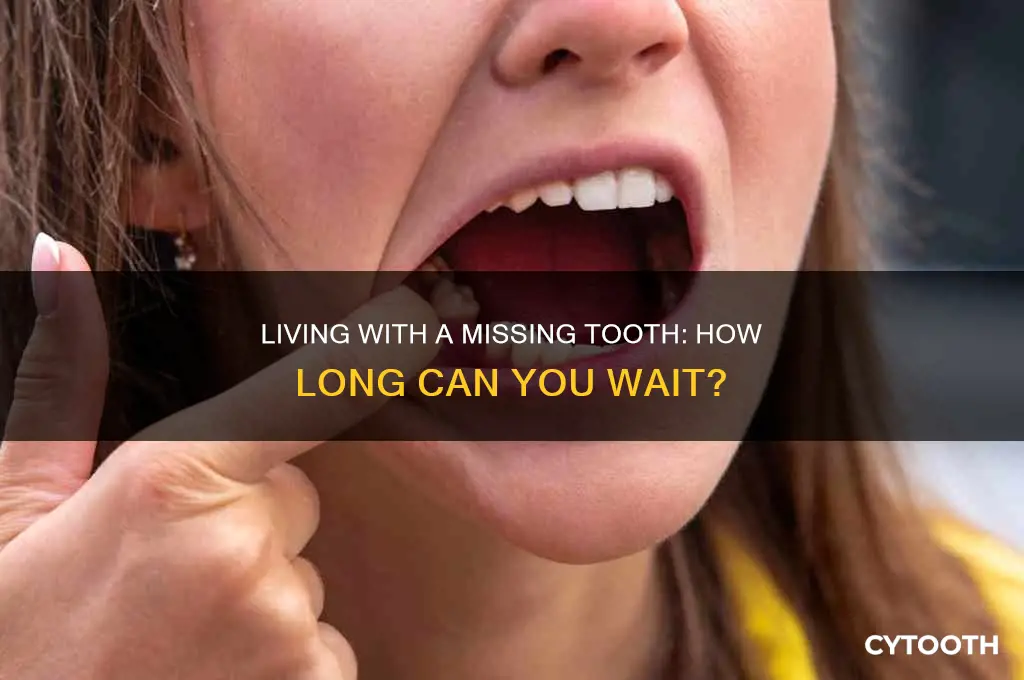
Dealing with a missing tooth can raise concerns about both oral health and appearance, leaving many to wonder how long they can safely go without addressing the issue. While it might seem like a minor inconvenience at first, a missing tooth can lead to a cascade of problems over time, including shifting teeth, jawbone deterioration, and difficulties with chewing or speaking. The duration one can go without replacing a missing tooth depends on various factors, such as the location of the tooth, overall oral health, and individual habits. However, it’s generally recommended to seek a solution promptly, as delaying treatment can exacerbate complications and make future interventions more complex. Options like dental implants, bridges, or dentures can restore function and aesthetics, ensuring long-term oral health and confidence.
| Characteristics | Values |
|---|---|
| Immediate Effects | Difficulty chewing, speech changes, aesthetic concerns |
| Short-Term (1-6 months) | Adjacent teeth may shift, increased risk of gum disease, bone loss begins |
| Long-Term (6 months - 2 years) | Significant bone loss, misalignment of teeth, TMJ issues |
| Extended Period (2+ years) | Severe bone atrophy, difficulty in dental implant placement, facial collapse |
| Recommended Action Time | Immediate consultation; replacement within 3-6 months |
| Replacement Options | Dental implants, bridges, dentures |
| Health Risks | Increased risk of periodontal disease, tooth decay in adjacent teeth |
| Aesthetic Impact | Smile alteration, potential facial asymmetry |
| Functional Impact | Reduced chewing efficiency, altered bite alignment |
| Psychological Impact | Self-esteem issues, social anxiety |
| Age Factor | Older adults may experience faster bone loss |
| Bone Loss Rate | 25% of bone volume lost in the first year |
| Preventive Measures | Regular dental check-ups, maintaining oral hygiene |
What You'll Learn

Impact on chewing and digestion
A missing tooth isn't just a gap in your smile—it's a disruption to your body's intricate chewing mechanism. This disruption can have a ripple effect on digestion, starting right in your mouth. Saliva, the first step in breaking down food, mixes less effectively with larger, poorly chewed particles. This means more work for your stomach and intestines, potentially leading to discomfort, bloating, and even nutrient malabsorption.
Imagine trying to mash potatoes with a fork missing a tine. It's possible, but inefficient and frustrating. Similarly, a missing tooth forces your remaining teeth to compensate, often leading to uneven wear and strain on your jaw muscles. This imbalance can result in jaw pain, headaches, and even temporomandibular joint (TMJ) disorders over time.
The impact on digestion extends beyond the mechanical. Poorly chewed food spends more time in the stomach, delaying the release of digestive enzymes and slowing the entire process. This can lead to feelings of fullness, indigestion, and even constipation. Think of it as a traffic jam in your digestive system, caused by oversized food particles struggling to move through.
While the body can adapt to some extent, the longer a tooth remains missing, the greater the strain on your system. Studies suggest that even a single missing tooth can significantly reduce chewing efficiency by up to 20%. This translates to a noticeable difference in how well you break down food, impacting nutrient absorption and overall digestive health.
Addressing a missing tooth isn't just about aesthetics; it's about preserving your body's natural ability to process food. Dental implants, bridges, or dentures can restore proper chewing function, alleviating the strain on your digestive system and promoting overall well-being. Remember, a healthy smile isn't just about looking good – it's about feeling good, inside and out.
Emergency Dental Care: Keeping a Knocked-Out Tooth Moist for Preservation
You may want to see also
Shifting of adjacent teeth over time
Teeth don't stay put when a neighbor goes missing. The gap left by a missing tooth creates a void in the intricate balance of your bite. Over time, adjacent teeth, no longer held in place by their counterpart, begin to drift into the empty space. This gradual shifting, known as mesial migration, can have significant consequences for your oral health.
Imagine a row of dominoes. Remove one, and the rest will eventually topple, disrupting the entire line. Similarly, a missing tooth sets off a chain reaction, causing neighboring teeth to tilt, rotate, or even erupt further out of their sockets. This movement isn't immediate, but it's relentless.
The speed of this shifting varies. Factors like the location of the missing tooth, the health of the surrounding gums and bone, and individual jaw structure all play a role. Generally, the longer a tooth remains missing, the more pronounced the shifting becomes. Within the first year, noticeable changes can occur, with more significant movement happening over 3-5 years.
In the short term, this shifting might seem like a purely aesthetic concern, leading to crooked teeth and an uneven smile. However, the implications go far beyond appearance. Misaligned teeth are harder to clean, increasing the risk of gum disease and tooth decay. The altered bite can also lead to jaw pain, headaches, and even difficulty chewing and speaking.
Preventing this domino effect is crucial. Dental implants, bridges, or partial dentures are effective solutions to fill the gap and maintain the integrity of your bite. These options not only restore your smile but also prevent the long-term complications associated with tooth migration. Remember, addressing a missing tooth promptly is an investment in your oral health and overall well-being.
Saving a Cracked Tooth Under a Crown: Is It Possible?
You may want to see also
Bone loss in the jaw area
The jawbone is not static; it requires stimulation from tooth roots to maintain its density and structure. When a tooth is lost, the absence of this stimulation triggers a natural process called resorption, where the body begins to break down the bone in that area. This bone loss is not immediate but progresses over time, typically starting within the first year after tooth extraction. The rate of resorption varies, but studies show that the jawbone can lose 25% of its volume in the first year alone, and this process continues at a slower rate in subsequent years.
To mitigate bone loss, timing is critical. The sooner a missing tooth is replaced, the better the chances of preserving the jawbone. Dental implants, for instance, act as artificial tooth roots, providing the necessary stimulation to halt bone resorption. However, if too much bone is lost, additional procedures like bone grafting may be required before an implant can be placed. For adults over 50, bone loss occurs more rapidly due to decreased bone density and slower healing, making prompt action even more essential.
Comparing tooth replacement options highlights the importance of addressing bone loss. Dentures and bridges, while functional, do not stimulate the jawbone and thus do not prevent resorption. In contrast, implants are the only solution that mimics the natural tooth structure, preserving bone integrity. For example, a 20-year longitudinal study found that patients with dental implants retained 90% of their jawbone density, compared to 40% in those using traditional bridges. This underscores the long-term benefits of choosing implants over other options.
Practical steps can be taken to minimize bone loss while planning for tooth replacement. Maintaining good oral hygiene reduces the risk of infection, which can accelerate bone resorption. A diet rich in calcium, vitamin D, and phosphorus supports bone health, while avoiding smoking is crucial, as it impairs blood flow and slows healing. For those considering implants, consult a dentist within 3–6 months of tooth loss to assess bone density and explore options. Delaying beyond a year significantly complicates treatment and increases costs.
In conclusion, bone loss in the jaw area is a silent but irreversible consequence of a missing tooth. Its progression is gradual but relentless, impacting not only oral health but also facial structure and self-esteem. By understanding the mechanisms of bone resorption and taking proactive steps, individuals can preserve their jawbone and maintain long-term oral function. The key takeaway is clear: act swiftly, choose wisely, and prioritize solutions that protect the jawbone’s integrity.
Flying After a Tooth Extraction: What You Need to Know
You may want to see also
Aesthetic and confidence concerns
A missing tooth can significantly alter your smile's symmetry, drawing attention to the gap and potentially overshadowing your other features. This visual imbalance often becomes a focal point, not just for you but for those you interact with, amplifying self-consciousness in social or professional settings.
Consider the psychological impact: studies show that individuals with visible dental imperfections report higher levels of anxiety during public speaking or photo-taking. For instance, a 2019 survey by the American Academy of Cosmetic Dentistry found that 74% of adults feel an imperfect smile harms their career success. Even temporary solutions like dental floss with wax to conceal gaps can provide immediate relief, though they’re not long-term fixes.
From a comparative standpoint, the aesthetic fallout of a missing tooth worsens over time. Surrounding teeth may shift, altering bite alignment and causing adjacent teeth to tilt into the gap. This not only exacerbates the visual issue but can make future restorative procedures, like implants or bridges, more complex. Addressing the gap within 3–6 months minimizes these risks, preserving both appearance and function.
For those delaying treatment, practical tips can mitigate immediate concerns. Using dental makeup (tooth-colored resins) or partial dentures can temporarily restore aesthetics, though these solutions lack the durability of permanent options. Pairing these with confidence-building strategies, such as focusing on strengths during conversations or practicing positive self-talk, can help bridge the gap until definitive treatment is pursued.
Ultimately, the aesthetic and confidence concerns tied to a missing tooth are not merely superficial—they intersect with oral health and psychological well-being. While short-term fixes offer relief, prioritizing permanent solutions like implants or bridges within a year ensures long-term confidence and prevents compounding issues. Ignoring the gap risks more than just your smile; it chips away at self-assurance in ways that ripple through every facet of life.
Can You Spot a Tooth Filling Without a Microscope?
You may want to see also
Increased risk of gum disease
A missing tooth isn’t just a gap in your smile—it’s an open invitation for gum disease. The absence of a tooth disrupts the natural balance of your oral ecosystem, creating spaces where bacteria thrive. Without the protective structure of a tooth, gums become more susceptible to infection, leading to conditions like gingivitis or periodontitis. This isn’t merely a cosmetic issue; it’s a health risk that escalates the longer the gap remains untreated.
Consider the mechanics: teeth are designed to work together, supporting each other and maintaining gum tissue integrity. When one is missing, adjacent teeth may shift, causing gum pockets to form. These pockets trap food particles and bacteria, fostering inflammation and infection. Over time, this can erode the gum line and even damage the underlying bone. For adults over 40, this risk is particularly acute, as age-related gum recession already compromises oral health.
Preventing this cascade starts with prompt action. If a tooth is lost, consult a dentist within 3–6 months to discuss replacement options like implants, bridges, or partial dentures. Until then, maintain meticulous oral hygiene: brush twice daily with a soft-bristled toothbrush, floss around the gap to remove debris, and use an antimicrobial mouthwash to reduce bacterial buildup. Avoid smoking, as it impairs blood flow to gums and slows healing.
Compare this to ignoring the issue: studies show that untreated tooth loss doubles the risk of gum disease within the first year. For diabetics or immunocompromised individuals, the consequences are even more severe, as infections can spread systemically. Early intervention isn’t just about preserving your smile—it’s about safeguarding your overall health.
In essence, a missing tooth isn’t a static problem; it’s a ticking clock for gum disease. Act swiftly, adopt rigorous oral care habits, and seek professional solutions to halt the progression. Your gums—and the rest of your body—will thank you.
Can Retainers Cause Tooth Death? Understanding the Risks of Tight Wear
You may want to see also
Frequently asked questions
You can go without a missing tooth for a short period, but it’s best to address it within 3–6 months to avoid complications like shifting teeth, bone loss, or bite problems.
No, leaving a missing tooth untreated indefinitely can lead to serious oral health issues, including jawbone deterioration, misalignment of surrounding teeth, and increased risk of gum disease.
Bone loss begins almost immediately after a tooth is lost, with about 25% of the bone volume lost within the first year and continuing to deteriorate over time.
Waiting a year or more to replace a missing tooth is not recommended, as it increases the risk of complications and may require more extensive treatment, such as bone grafting, to restore oral health.
Yes, a missing tooth can impact overall health if left untreated. It can lead to difficulty chewing, poor nutrition, speech issues, and even contribute to systemic conditions like heart disease or diabetes due to increased inflammation and infection risk.