Hailey Morgan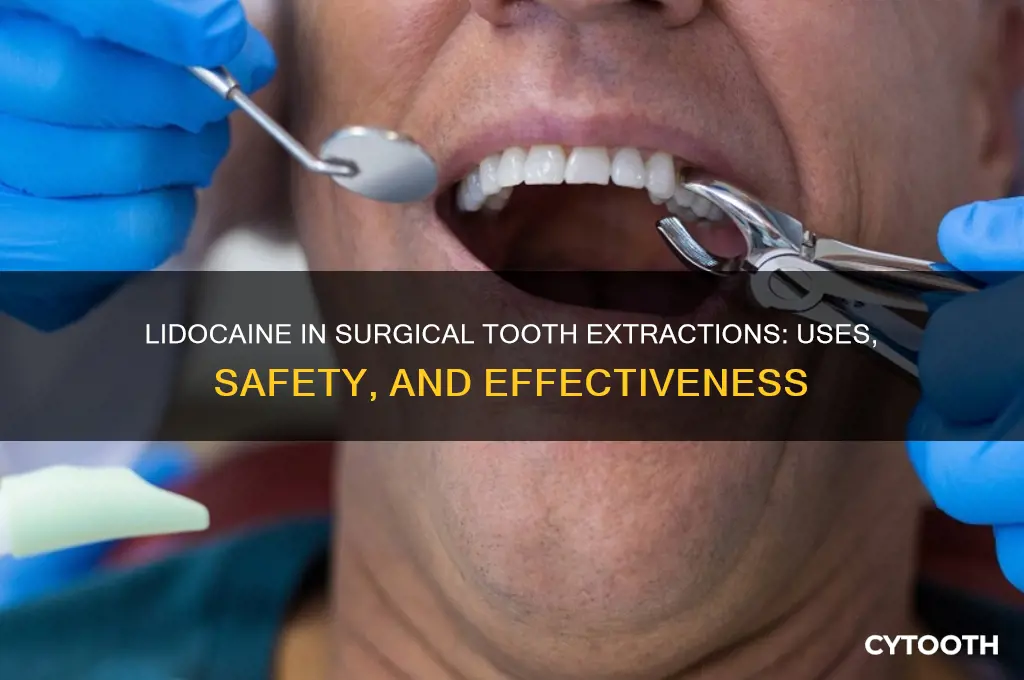
Lidocaine, a commonly used local anesthetic, is frequently employed in dental procedures to numb the area around a tooth prior to extraction. Its effectiveness in blocking pain signals makes it a go-to choice for both simple and surgical tooth extractions. In surgical extractions, where the tooth may be impacted, broken, or require more complex removal techniques, lidocaine ensures patient comfort by providing profound anesthesia to the surrounding tissues, including the gums, bone, and nerves. However, its use must be carefully tailored to the patient’s medical history, as factors such as allergies, cardiovascular conditions, or concurrent medications can influence its safety and efficacy. When administered correctly, lidocaine plays a critical role in facilitating surgical tooth extractions by minimizing pain and allowing the dentist or oral surgeon to perform the procedure with precision.
What You'll Learn

Lidocaine efficacy for tooth extraction
Lidocaine, a widely used local anesthetic, is a cornerstone in dental procedures, including surgical tooth extractions. Its efficacy stems from its ability to block nerve signals, providing rapid and effective pain relief. Typically administered via infiltration or nerve block, lidocaine ensures patient comfort during invasive procedures. The standard dosage for dental use ranges from 1.8 to 3.6 mg/kg, with a maximum safe dose of 7 mg/kg. For adults, this often translates to 1.8 mL to 3.6 mL of a 2% lidocaine solution, depending on the complexity of the extraction and patient factors like weight and medical history.
The effectiveness of lidocaine in surgical tooth extractions is well-documented, but its success depends on proper technique and patient-specific considerations. For instance, in cases of impacted molars or multi-rooted teeth, a combination of infiltration and nerve block (e.g., inferior alveolar block) may be necessary to achieve adequate anesthesia. Dentists must also account for individual variability in lidocaine metabolism, particularly in patients with liver dysfunction, as this can affect the drug’s duration and intensity. Adding a vasoconstrictor like epinephrine (1:100,000) to the lidocaine solution can prolong its action and reduce systemic absorption, enhancing both safety and efficacy.
While lidocaine is highly effective, its limitations must be acknowledged. For example, patients with allergies to amide-type anesthetics or those with severe cardiovascular conditions may require alternative agents. Additionally, lidocaine’s onset time of 2–3 minutes and duration of 30–60 minutes may not suffice for prolonged or particularly complex extractions. In such cases, supplemental anesthesia or adjuvant techniques, such as intraligamental injection, may be employed. Proper patient communication is also critical; pre-procedure explanations of sensations (e.g., pressure but not pain) can reduce anxiety and improve cooperation.
Practical tips for optimizing lidocaine’s efficacy include warming the solution to body temperature to reduce discomfort upon injection and using a slow, steady injection technique to minimize tissue trauma. For pediatric patients or anxious adults, topical anesthetics like 20% benzocaine gel can be applied to the mucosal surface prior to needle insertion. Post-procedure, patients should be advised to avoid eating or drinking until the numbness subsides to prevent accidental injury. By combining technical precision with patient-centered care, lidocaine remains a reliable and versatile tool for surgical tooth extractions.
Post-Tooth Extraction Soccer: Safe Play Guidelines for Kids
You may want to see also
Dosage and administration guidelines
Lidocaine is a widely used local anesthetic in dental procedures, including surgical tooth extractions. Its effectiveness hinges on precise dosage and administration to ensure patient comfort and safety. The recommended dosage for adults typically ranges from 1.8 to 3.6 mg/kg of 2% lidocaine solution, with a maximum dose of 300–400 mg per procedure. For pediatric patients, the dosage is adjusted based on weight, generally not exceeding 5 mg/kg to avoid systemic toxicity. Always consider the patient’s medical history, especially cardiovascular or hepatic conditions, which may alter lidocaine metabolism.
Administration technique is as critical as dosage. For surgical extractions, a block injection (e.g., inferior alveolar nerve block) is commonly employed to achieve profound anesthesia. Aspirate before injecting to prevent intravascular administration, which can lead to systemic complications. Buffering lidocaine with sodium bicarbonate can reduce discomfort during injection and improve tissue penetration. For patients with needle anxiety, topical anesthetics like 20% benzocaine gel can be applied to the mucosal surface prior to injection.
The duration of lidocaine’s effect is approximately 30–60 minutes for 2% solutions, though this can vary based on the patient’s physiology and the addition of vasoconstrictors like epinephrine. When using lidocaine with epinephrine (1:100,000 concentration), exercise caution in patients with hypertension or cardiovascular disease, as epinephrine can elevate blood pressure and heart rate. For such cases, consider using lidocaine without a vasoconstrictor or alternative anesthetics like articaine.
Practical tips include warming the lidocaine solution to body temperature to minimize pain during injection and ensuring the patient is seated comfortably to reduce anxiety. Post-injection, monitor for signs of local anesthetic toxicity, such as dizziness, tinnitus, or seizures, which may occur with overdose or rapid absorption. In emergency cases, lipid rescue therapy can be administered to reverse severe lidocaine toxicity.
In summary, lidocaine’s role in surgical tooth extractions is indispensable, but its use demands meticulous attention to dosage, administration technique, and patient-specific factors. Adhering to these guidelines ensures optimal analgesia while minimizing risks, making it a cornerstone of safe and effective dental anesthesia.
Infected Tooth Extraction: Link to Swollen Tonsils Explained
You may want to see also
Potential side effects and risks
Lidocaine is a commonly used local anesthetic in dental procedures, including surgical tooth extractions. While it is generally safe and effective, understanding its potential side effects and risks is crucial for both patients and practitioners. The most immediate concern is an allergic reaction, which, although rare, can manifest as skin rashes, itching, or, in severe cases, anaphylaxis. Patients with a history of hypersensitivity to amide-type anesthetics should inform their dentist to avoid such risks. Additionally, lidocaine contains preservatives like methylparaben, which can also trigger allergic responses in sensitive individuals.
Another significant risk is related to dosage and administration. Lidocaine’s maximum safe dose for adults is typically 7 mg/kg of body weight, but exceeding this can lead to systemic toxicity. Symptoms of overdose include numbness around the mouth, dizziness, seizures, and, in extreme cases, cardiac arrhythmias. Elderly patients or those with compromised liver function are particularly vulnerable, as their bodies may metabolize lidocaine more slowly, increasing the risk of accumulation and toxicity. Dentists must carefully calculate the dose based on the patient’s weight, medical history, and concurrent medications to minimize these risks.
Local side effects at the injection site are also common but usually mild. These include pain, swelling, or bruising, which typically resolve within a few days. However, improper needle placement can lead to more serious complications, such as nerve damage or hematoma formation. For instance, injecting lidocaine too close to the inferior alveolar nerve during a lower molar extraction can cause temporary or, rarely, permanent numbness in the lip and chin. Dentists should use proper techniques, such as aspirating before injecting to avoid intravascular administration, to reduce these risks.
Finally, lidocaine’s interaction with other medications warrants attention. Patients taking certain drugs, such as beta-blockers or class I antiarrhythmics, may experience heightened sensitivity to lidocaine’s effects. Similarly, those on anticoagulants like warfarin may have an increased risk of bleeding at the extraction site. Patients should provide a complete medical history, including over-the-counter medications and supplements, to ensure safe use of lidocaine. Post-procedure, patients should monitor for unusual symptoms and follow their dentist’s aftercare instructions closely to mitigate potential complications.
Sippy Cups Post-Tooth Extraction: Safe for Kids or Not?
You may want to see also
Alternatives to lidocaine in dentistry
Lidocaine is a staple in dentistry for local anesthesia, but its use isn’t without limitations. Allergic reactions, contraindications in certain patients, or the need for longer-lasting effects can prompt dentists to seek alternatives. One such alternative is articaine, a local anesthetic with a similar onset time to lidocaine but a longer duration of action. Articaine is often preferred for posterior tooth extractions due to its efficacy in achieving profound anesthesia in the mandibular region. A typical dosage is 36 mg per cartridge, with a maximum recommended dose of 7 mg/kg body weight. However, it contains a sulfur-based preservative, which may limit its use in patients with sulfite sensitivities.
For patients with lidocaine allergies or those requiring a vasoconstrictor-free option, mepivacaine emerges as a viable substitute. Mepivacaine has a slightly slower onset compared to lidocaine but offers a comparable duration of anesthesia. It is particularly useful in patients with cardiovascular concerns, as it is less likely to cause systemic vasoconstriction. A standard concentration of 2% mepivacaine is commonly used, with a maximum dose of 4.4 mg/kg. Dentists should exercise caution in patients with hepatic impairment, as mepivacaine’s metabolism is liver-dependent.
Another alternative gaining traction is septocaine, a combination of articaine and the vasoconstrictor epinephrine. This formulation provides rapid onset and extended duration, making it ideal for surgical extractions. Septocaine’s unique advantage lies in its ability to reduce bleeding during procedures, thanks to epinephrine’s vasoconstrictive properties. A 4% solution with 1:100,000 epinephrine is commonly administered, though epinephrine-free versions are available for patients with hypertension or cardiovascular disease. Dentists must monitor blood pressure during use to avoid adverse reactions.
In pediatric dentistry or cases requiring minimal tissue irritation, prilocaine is often considered. Prilocaine is frequently combined with lidocaine in a 50/50 mixture (EMLA cream) for topical anesthesia, but it can also be used independently for local infiltration. Its lower toxicity profile compared to lidocaine makes it safer for children, though its duration of action is shorter. A 4% prilocaine solution is typically used, with a maximum dose of 6 mg/kg. However, its metabolite, o-toluidine, can cause methemoglobinemia in rare cases, particularly in infants under six months.
Finally, for patients seeking non-injectable alternatives, benzocaine offers a topical solution. While not suitable for surgical extractions requiring deep anesthesia, benzocaine can be used for surface anesthesia to reduce discomfort during needle insertion. It is available in concentrations up to 20% and is particularly useful in anxious patients. However, its short duration and risk of methemoglobinemia limit its application. Dentists should avoid using benzocaine in children under two years old due to safety concerns.
In summary, while lidocaine remains a cornerstone in dental anesthesia, alternatives like articaine, mepivacaine, septocaine, prilocaine, and benzocaine provide tailored solutions for specific patient needs. Each option comes with its own set of advantages, dosages, and precautions, allowing dentists to choose the most appropriate anesthetic for the procedure and patient profile.
Invisalign and Tooth Extraction: Can They Work Together Effectively?
You may want to see also
Post-extraction pain management options
Lidocaine, a common local anesthetic, is frequently used during surgical tooth extractions to numb the area and ensure patient comfort. However, its role doesn’t end there—lidocaine can also be part of a broader post-extraction pain management strategy. After the procedure, residual soreness, swelling, and discomfort are common, and addressing these symptoms effectively is crucial for recovery. Here’s how lidocaine and other options fit into the post-extraction pain management toolkit.
One practical approach is the use of lidocaine-based gels or ointments applied directly to the extraction site. These products, often containing 2–5% lidocaine, provide localized numbing to alleviate immediate pain. For example, a pea-sized amount of lidocaine gel applied gently to the affected area can offer relief for up to 2 hours. However, it’s essential to follow dosage instructions carefully, as overuse can lead to numbness in unintended areas or systemic absorption, particularly in children or elderly patients. Always consult a dentist or pharmacist for age-specific recommendations.
For more systemic pain relief, over-the-counter medications like ibuprofen (400–600 mg every 6 hours) or acetaminophen (500–1000 mg every 4–6 hours) are often recommended. These medications reduce inflammation and manage pain effectively when used as directed. Combining lidocaine gels with these oral analgesics can provide dual-action relief, targeting both localized discomfort and broader inflammatory responses. However, avoid using aspirin post-extraction, as it can increase bleeding risk.
In cases of severe pain or complex extractions, dentists may prescribe stronger medications, such as opioids or steroidal anti-inflammatory drugs. While these are effective, they come with risks, including dependency and side effects like nausea or dizziness. A comparative analysis shows that lidocaine-based options, when paired with NSAIDs, often provide sufficient relief without the drawbacks of heavier medications, making them a safer, first-line choice for most patients.
Finally, non-pharmacological methods complement these strategies. Applying a cold compress for 20 minutes on, 20 minutes off reduces swelling and numbs the area naturally. Soft foods, avoiding strenuous activity, and maintaining oral hygiene (gently rinsing with warm salt water after 24 hours) also aid recovery. By combining lidocaine’s localized action with these practical steps, patients can navigate post-extraction pain with greater ease and confidence.
Can Infections Lead to Bleeding After Tooth Extraction? Find Out Here
You may want to see also
Frequently asked questions
Yes, lidocaine is commonly used as a local anesthetic for surgical tooth extractions to numb the area and minimize pain during the procedure.
Lidocaine is generally safe for most patients, but it should be avoided in individuals with specific allergies, certain heart conditions, or those taking medications that interact with lidocaine. Always inform your dentist of your medical history.
The numbing effect of lidocaine typically lasts 30 minutes to 2 hours, depending on the dosage and formulation used. Your dentist may adjust the amount to ensure adequate anesthesia throughout the procedure.